Beyond the Horizon: The stories behind Phoenix’s 5 tallest giants
By Keith Pomonis
PHOENIX (Oct. 6, 2026) — When people think of Metro Phoenix, they usually picture a sprawling desert valley that goes on forever. But if you look toward downtown, you’ll find a unique architectural skyline shaped by a surprising rule.
Even though Phoenix is the fifth-largest city in the U.S., it technically doesn’t have a single official “skyscraper.” According to the Council on Tall Buildings, a skyscraper must stand at least 492 feet tall. Because Phoenix Sky Harbor International Airport sits right next to the urban core, strict FAA height restrictions have kept the skyline beautifully capped.
Despite these limits, the Valley has some incredible high-rises. Here are the top five tall buildings defining the Phoenix skyline, along with the history and quirks that make them special.
- Chase Tower: Oh, so close (483 feet)
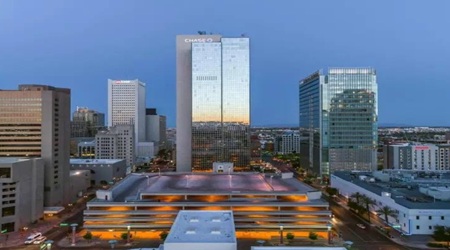
Since 1972, Chase Tower has held the title of the tallest building in Arizona. Originally built as the Valley Bank Center, its distinct cloverleaf shape occupies an entire city block.
- The History: It was built during a major 1970s downtown corporate boom. For decades, locals and tourists could ride up to the 39th floor to view the entire Valley from its public observation deck.
- Fun Fact: The tower sits on a massive underground pedestrian concourse that once bustled with shops. While the building has been entirely vacant since 2021, plans are currently underway to breathe new life into the giant by converting it into a mix of apartments and hotel rooms.
- The Maeve Central Station: The new kid on the block (424 feet)
The newest addition to the upper limits of the skyline is The Maeve Central Station, which officially wrapped up construction in 2025.
- The History: This 33-story tower completely reshaped the former transit hub at Central Avenue and Polk Street.
- Fun Fact: It represents a massive cultural shift in Phoenix. For decades, the city grew outward; this tower proves the city is now aggressively growing upward, packing a vibrant mix of residential apartments and retail spaces right into the urban core.
- U.S. Bank Center: The trailblazer (407 feet)
Completed in 1976, the 31-story U.S. Bank Center stands as a testament to late-70s corporate ambition.
- The History: It was built during a time when high-rise safety laws were still evolving across the country.
- Fun Fact: It secured a permanent spot in local history by becoming the very first high-rise building in Arizona to feature an automatic fire sprinkler system.
- CenturyLink Tower: The neon crown (397 feet)
Finished in 1989 and known natively to many locals as the Qwest Tower, this Midtown landmark brings a bit of artistic flair to the desert.
- The History: Built right at the tail end of the 80s boom, it was designed to anchor the commercial stretch of Central Avenue north of downtown.
- Fun Fact: It is easily the most recognizable building at night. Its roof features a decorative, pyramid-shaped crown lit with turquoise neon that illuminates the desert sky.
- Alliance Bank Tower: The modern landmark (385 feet)
Part of the bustling, modern CityScape development, the Alliance Bank Tower was completed in 2010.
- The History: It was built to revitalize downtown Phoenix, successfully bringing street-level energy, dining, and nightlife back to the city center.
- Fun Fact: Wrapped in sleek blue glass, its highly reflective exterior mirrors the intense Arizona sun, making it look completely different depending on the hour of the day.
While these five hold the records today, Phoenix’s horizontal legacy is about to meet a massive vertical shift. Developers have broken ground on the upcoming Arro project, a stunning mixed-use development. Its north tower is slated to reach 541 feet. Once it is finished, it will officially break the FAA glass ceiling and become Phoenix’s very first true skyscraper.
Keith Pomonis is the President of Mesa-based EHS Restoration. For more information call (480) 306-5777 or visit ehsrestoration.com.
 PHOENIX, Ariz. (Oct. 6, 2026) – Kidder Mathews has expanded its Phoenix Healthcare Services Group with the addition of three professionals: Amita Sall, Shannon Hamer, and Makai Rich, underscoring the firm’s continued growth and commitment to serving Arizona’s evolving healthcare real estate market.