Milagro on Oracle Wins Second Statewide Housing Award
TUCSON, AZ (Aug. 19, 2026) — The City of Tucson’s El Pueblo Housing Development and Gorman & Company have received a second statewide honor for Milagro on Oracle, the 63-unit affordable housing community created through the adaptive reuse of two historic motor courts along North Oracle Road.
The Arizona Multihousing Association presented Milagro on Oracle with its Developers Award for Best Community Design, Affordable Community, during an Aug. 7 ceremony in Phoenix. The awards recognize outstanding people, companies and projects in Arizona’s apartment and rental housing industry.
“Milagro on Oracle demonstrates that affordable housing can and should combine thoughtful design, quality construction, and a strong sense of community,” said Housing and Community Development Director Ann Chanecka.
Chanecka said the project reflects a shared commitment to expanding access to high-quality housing, strengthening the Oracle Road corridor, and creating lasting value for residents and the surrounding neighborhood.
The recognition follows another statewide award received in August 2025, when the Arizona Department of Housing named Milagro on Oracle its Urban Development of the Year Housing Hero Award recipient.
The $21 million development serves low-income residents age 55 and older, including formerly unhoused seniors through the Continuum of Care program. The project was completed in January 2025, when Tucson Mayor Regina Romero, then Arizona Department of Housing Director Joan Serviss, and Chanecka joined project partners to celebrate its opening.
Milagro on Oracle is located within both the Thrive in the 05 area and the Miracle Mile National Historic District. It was the first development completed by El Pueblo Housing Development, the City of Tucson’s nonprofit development entity, and represented Tucson’s first Low-Income Housing Tax Credit project in more than a decade.
That combination gives the project significance beyond its 63 residential units. Milagro on Oracle became an example of how an affordable housing development can address several community goals at once, including housing affordability, historic preservation, neighborhood reinvestment and the reuse of aging properties that otherwise might have continued to deteriorate.
The development’s most distinctive feature is the preservation and incorporation of two historic motor courts, the DeAnza Motel, later known as the No-Tel Motel, built in 1940, and the Don Motel, built in 1941. Both properties were part of the era when Oracle Road served as one of Tucson’s primary automobile gateways.
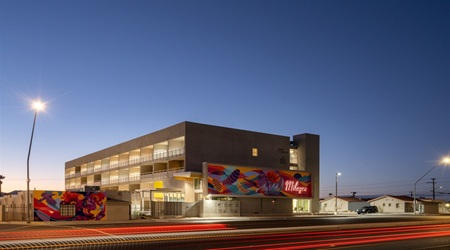
Rather than clearing the site and starting over, the development team worked to retain the historic character of the properties while adapting them for a new residential use. A new four-story, elevator-served structure was added to the site to provide additional housing while allowing significant portions of the original motor courts to remain part of the finished development.
“Milagro on Oracle is a beautiful example of historic preservation blended with new construction, honoring the past and celebrating the future with new, modern, and sustainable affordable housing for generations to come,” said Sally Schwenn, Arizona Market President for Gorman & Company.
The redevelopment was not without challenges. The age and condition of the original structures created structural and environmental issues that had to be addressed during design and construction. El Pueblo Housing Development and Gorman & Company ultimately incorporated the historically significant properties into a modern affordable housing community rather than treating the existing buildings as obstacles to new development.
The result preserves visible pieces of the corridor’s mid-century history while introducing new housing intended to meet current standards for accessibility, sustainability and long-term residential use.
Milagro on Oracle also incorporates public art as part of the redevelopment. Tucson artist Jessica Gonzales created a two-piece mural inspired by the area’s history as a mid-century vehicular gateway into Tucson. The artwork adds another connection between the new development and the history of the surrounding neighborhood.
The project is part of Tucson’s 10-point Housing Affordable Strategy for Tucson (HAST), which calls for increasing the city’s supply of affordable housing. It also advances goals contained in the Thrive in the 05 Transformation Plan, which focuses on sustainable, community-driven, and equitable reinvestment in Tucson’s historic northern gateway.
Those goals include not only attracting new investment but also reducing the potential for displacement as improvements occur within the area. Milagro on Oracle was designed to contribute to that effort by preserving affordable housing opportunities for residents who may be particularly vulnerable to rising housing costs.
El Pueblo Housing Development was created to develop stable, healthy and affordable housing and supportive services for residents of Tucson and Pima County. Its work includes both the development of new housing and the rehabilitation of existing properties for affordable rental and homeownership opportunities.
Milagro on Oracle was the organization’s first development, but it is part of a larger pipeline of affordable housing projects now underway in Tucson.
Additional developments being pursued by El Pueblo Housing Development include Tucson House, Sugar Hill on Stone, Amazon Flats, Stone and Speedway, and El Rincón at Main and Davis.
Together, those projects represent a broader City effort to add and preserve affordable housing across Tucson while using redevelopment as a tool to strengthen existing neighborhoods.
For Milagro on Oracle, the latest Arizona Multihousing Association award adds another recognition to a project that has already drawn statewide attention for combining affordable senior housing with historic preservation and neighborhood revitalization.
Its second statewide award also underscores the role adaptive reuse can play as Tucson looks for ways to address housing needs without losing the architectural and cultural history that distinguishes many of the city’s older commercial corridors.