TUCSON, AZ (July 21, 2026) — Tucson’s industrial market returned to positive absorption during the second quarter of 2026, although recently completed projects and tenant move-outs over the past year continued to place upward pressure on vacancy, according to CBRE’s latest market report.
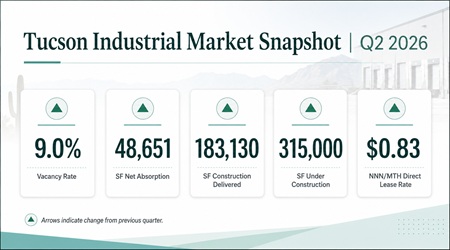
The metro recorded 48,651 square feet of positive net absorption during the quarter, reversing the approximately 220,000 square feet of negative absorption reported in the first quarter. The improvement marked a welcome change after several uneven quarters, but it was not enough to offset the 171,000 square feet of negative absorption accumulated during the first half of the year.
Overall industrial vacancy increased to 9.0%, up from 8.8% in the previous quarter and 4.4% one year earlier. Tucson’s vacancy rate has now climbed 630 basis points from the 2.7% recorded in the second quarter of 2023, reflecting the market’s transition from historically tight conditions to a period of greater tenant choice.
Availability, which includes space expected to become available within six months, reached 10.7%. Sublease vacancy remained minimal at just 0.1%, indicating that most of the available space is being marketed directly by property owners rather than by tenants.
Despite the increase in vacancy, asking rents continued to rise. The average direct asking rate reached $0.83 per square foot per month, triple net, representing a 3.8% increase from the first quarter and a 13.7% gain from the same period last year. Average rents remain below the market’s recent peak of $0.94 per square foot recorded in early 2024.
Vacancy and rental conditions varied considerably by submarket. West Central posted the lowest vacancy rate at 1.8%, followed by East Central at 2.5% and Northeast at 3.5%. The Airport submarket recorded the highest vacancy at 12.0%, followed by Southeast at 10.7% and Southwest at 8.0%.
The Airport submarket nevertheless led Tucson in quarterly demand, recording 50,000 square feet of positive net absorption. Northwest followed with 30,000 square feet, while Southwest added 10,000 square feet. Southeast and East Central reported smaller gains.
West Central was the only submarket to post a significant quarterly loss, with 47,000 square feet of negative net absorption.
By property type, research and development and flex space generated the strongest quarterly performance, with 48,000 square feet of positive absorption. General manufacturing recorded 19,000 square feet, while distribution and logistics properties posted 15,000 square feet of negative absorption.
The distribution and logistics category, which accounts for approximately 23.47 million square feet of Tucson’s 43.52-million-square-foot industrial inventory, also carried the market’s highest major product vacancy rate at 11.4%.
Smaller industrial buildings remained the tightest segment of the market. Properties containing less than 50,000 square feet posted a vacancy rate of only 2.3%, compared with 17.9% among buildings ranging from 100,000 to 249,999 square feet. The contrast demonstrates that smaller functional spaces remain difficult to replace even as availability has increased among larger warehouses.
Leasing activity slowed during the quarter, with approximately 97,000 square feet leased. That represented a 57.1% decline from the first quarter and a 59.2% decrease from the second quarter of 2025.
Southeast accounted for 36.7% of recorded leasing activity, followed by Northwest at 32.5%, Airport at 25.7% and Southwest at 5.1%.
Among the quarter’s largest transactions, NEFCO leased 24,000 square feet at 2567 E. Commerce Center Plaza, and Freeport Minerals leased 17,000 square feet at 3231 E. Valencia Road. Semper Fi Heating and Cooling leased 12,000 square feet at 2155 N. Forbes Blvd., while VXI Global leased 10,000 square feet at 4755–4775 S. Butterfield Drive.
Development activity has contracted substantially from its recent peak. Approximately 315,000 square feet was under construction at the end of the second quarter, down 74% from one year earlier and well below the 1.3 million square feet underway during the second quarter of 2023.
All current construction is concentrated in a single Southeast warehouse-and-storage project at 9688 E. Old Vail Road, which is scheduled for completion in the fourth quarter.
CBRE said Tucson’s broader economic fundamentals remain supportive despite higher interest rates and national economic uncertainty. Population growth, relative affordability, available land and continued investment in semiconductor and advanced manufacturing operations are expected to support long-term industrial demand.
The market may also benefit from companies seeking lower operating costs or alternatives to Phoenix, particularly as elevated borrowing costs constrain speculative development in larger metropolitan markets.
For the near term, however, Tucson’s industrial sector remains in a period of adjustment. Positive second-quarter absorption and rising rents point to continued tenant demand, but elevated vacancy, modest leasing activity, and negative year-to-date absorption indicate that the market will need additional growth to work through recently added supply.Tucson Industrical Figures Q2
Read the full report here
 Communitywide water drive across nine Arizona offices will help provide life-saving hydration resources for people experiencing homelessness.