Costco’s Lesson for Tucson: Good Management Shows

By Craig J. Cantoni

TUCSON, AZ (July 10, 2026) — The July 9th edition of the Wall Street Journal had a story set in Tucson.

The 1,570-word story featured a long-tenured Costco employee who works on the checkout line at a Costco store in Tucson — specifically, the store I patronize on Grant Road, just west of Tanque Verde Road. The employee earns nearly $33 an hour and has accumulated more than $1 million in his 401(k).

He is an example of the benefits of working for Costco, a company with a management philosophy of treating employees well, which in turn results in them treating customers well—which in turn makes the company successful.

This isn’t as unusual in America as the popular anti-business narrative suggests. I worked for two manufacturing companies that had the same philosophy, which is why I worked for them. Factory workers retired as millionaires.

Both companies were privately-held, family-owned businesses. One of them was the global giant Mars, Inc.

I worked at the headquarters of its US confectionery business in New Jersey. As was Mars’ custom, the office was connected to a plant, so that white-collar managers and employees never forgot what made the company successful.

When one of the two billionaire brothers who ran the far-flung operation would come to town, the first thing he would do was go into the plant and talk with longtime employees he knew personally, asking how they were doing and how they were being treated.

The owners were also fastidious about cleanliness, upkeep, and being good neighbors. The lawn and landscaping in front of the plant looked like a putting green on a championship golf course.

Judging by how the Mars brothers dressed, the mid-priced rental cars they drove, and the mid-tier hotels they stayed at, you wouldn’t know they were billionaires.

On a related note, when I was at the Grant Rd. Costco a few weeks ago, the CEO of the company was at the store. He was unpretentious, affable, and clearly well-liked by employees. Standing in the check-out area, he was applauding employees for their service with the company.

A cautionary note: Treating employees well and paying them well is a surefire way of going out of business unless there is a commensurate level of productivity, efficiency,

and quality. Accomplishing both requires not only investments in people but also investments in maintenance and state-of-the-art technology and equipment. Other essential prerequisites are high expectations and a low tolerance for mediocrity.

This prescription for success applies to nations as well. Unfortunately, the second part of the formula is overlooked by those who believe that a higher minimum wage and/or socialism alone will magically remedy America’s socioeconomic problems.

Masochists who regularly read my essays know that I’m fixated on aesthetics and upkeep. That’s because, as I have learned repeatedly, how a place looks is an indicator of how it is managed. This is true for both businesses and cities.

If, for example, a restaurant doesn’t have enough pride to keep its parking lot and frontage nicely landscaped and maintained, there’s a high probability that its kitchen isn’t clean. And if litter and weeds are in abundance outside of a retail store, there’s a high probability that the place will be badly managed and staffed with surly employees.

Unsurprisingly, the Costco parking lot is spotless. So are the loading docks in the rear of the store.

The same holds for a city. There’s a high likelihood that a city is badly governed if streets aren’t nicely landscaped and paved, if litter isn’t picked up, if illegal signage is allowed to proliferate, if property maintenance codes aren’t enforced, and if seediness and shabbiness are widespread.

By those indicators, Tucson and Pima County do not need another slogan, task force, or vision statement. They need basic management discipline.

_______________________________________

Mr. Cantoni is a freelance writer, author of a management book, former business executive, and advocate for public policy reform. He later founded a management consultancy whose clients included Houston-based Weingarten Realty Investors. He now lives in Tucson.
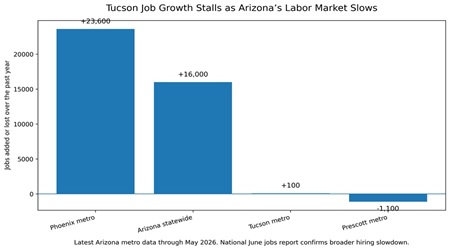


Tucson Job Growth Stalls as Arizona’s Labor Market Slows

Tucson Job Growth

(JULY 10, 2026) — Arizona’s labor market continues to show resilience, but the latest employment data shows a clear slowdown—especially in Southern Arizona.

Statewide, Arizona added 2,000 seasonally adjusted jobs in May, while the unemployment rate rose to 4.8%, above the national rate of 4.3%. On a non-seasonally adjusted basis, the state lost 14,300 jobs during the month, reflecting the usual seasonal slowdown that often accompanies the start of summer.

Economists say employers remain cautious as they navigate economic uncertainty, elevated borrowing costs, rising energy costs and a shrinking labor force. While Arizona is still outperforming many states over the longer term, the pace of hiring has moderated considerably.

For Tucson, the slowdown is more pronounced.

The Tucson metropolitan area added just 100 jobs over the past year, representing virtually flat employment growth of 0.02%. Through May, Tucson employment was down 0.5% year over year, underscoring the region’s continued struggle to build sustained job momentum.

Tucson’s strongest gains came from professional and business services, private education and health services, and other services. But those gains were offset by losses in several key sectors, including leisure and hospitality, government, construction, manufacturing, financial activities, and trade, transportation, and utilities.

The weakness in leisure and hospitality is particularly notable because it mirrors a broader national trend. Across the country, slower consumer spending has weighed on jobs in the accommodation and food services sector, which shed 55,000 positions in June. Those jobs are often an important entry point for younger workers, and the decline points to a softer hiring environment for early-career employees.

Nationally, the June jobs report confirmed a broader hiring slowdown, while the latest Arizona metro data show Tucson’s labor market remained nearly flat through May. According to the U.S. Bureau of Labor Statistics’ Employment Situation Summary for June 2026, employers added just 57,000 jobs nationally, the lowest monthly gain since March. Revisions to April and May job gains lowered prior job gains by 74,000, suggesting the labor market remains fragile even as the unemployment rate ticked down to 4.2%.

That decline in the national unemployment rate was not necessarily a sign of stronger hiring. Economists say it reflected a shrinking labor supply, with more than 700,000 people leaving the labor force in June. Labor force participation fell to 61.5%, down 80 basis points from a year earlier.

The labor supply challenge is being driven by several forces, including retirements, restrictive immigration policy, and slower population growth. The effects are being felt across age groups, but the steepest recent decline in participation came among workers ages 25 to 34. At the same time, employers appear to be favoring more experienced workers and productivity-enhancing technology investments over entry-level hiring.

For Tucson, that trend raises important economic development questions. A region already struggling to generate job growth cannot afford prolonged weakness in sectors that support young workers, service employment, construction activity and small business formation.

Phoenix continues to perform better than the rest of the state. The Phoenix metro area added 23,600 jobs over the past year and posted 0.3% year-to-date job growth through May, slightly ahead of the national pace. Its gains were led by private education and health services and professional and business services.

Tucson, by contrast, remains nearly flat.

Arizona’s overall economy continues to show resilience, but the divide between Phoenix and the rest of the state is widening. In Southern Arizona, the latest numbers point to a labor market that is not collapsing but is not gaining enough ground either.

With higher financing costs, rising operating expenses, and a shrinking pool of available workers, many employers appear content to hold current staffing levels until conditions become clearer. That caution may be understandable, but for Tucson, the challenge is larger: converting long-discussed economic development opportunities into measurable job growth.

U.S. Bureau of Labor Statistics, “The Employment Situation — June 2026


Two 16-Unit Central Tucson Apartment Properties Sell for $2.48 Million

Tucson Apartment Properties
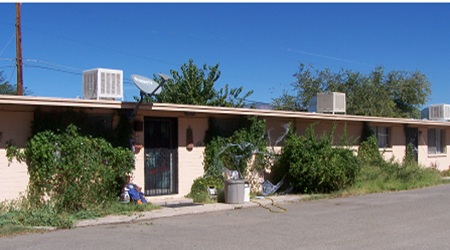
Park Manor Apartments

TUCSON, ARIZONA (July 9, 2026) — Two 16-unit apartment communities in central Tucson recently sold in separate transactions totaling $2.48 million.

JVC 4 Enterprises LLC purchased Park Manor Apartments, a 16-unit apartment complex at 3850-3880 N. Park Ave. in Tucson, from the Douglas E. and Andrea S. Robson Revocable Trust and the Gary H. Rieman and Phyllis C. Rieman Trust for $1.45 million.

The 8,840-square-foot complex was built in 1962 and sold for $90,625 per unit, or $160.68 per square foot. The property includes three single-story buildings on approximately 1.1 acres, with 12 one-bedroom/one-bath units and four two-bedroom/one-bath units, off-street parking and a walled yard.

Romero Apartments

In the second transaction, Sunflower Properties AZ LLC purchased Romero Apartments, a 16-unit apartment complex at 3502, 3510, 3518 and 3526 N. Romero Road in Tucson, from Romero Property LLC for $1.03 million. The 10,688-square-foot complex was built in 1964 and sold for $64,375 per unit, or $31.51 per square foot. The property consists of four fourplexes on approximately 1.1 acres, with 10 two-bedroom/one-bath units of approximately 700 square feet and six one-bedroom/one-bath units of approximately 500 square feet.

Allan Mendelsberg and Joey Martinez, Principals and Multifamily specialists with Cushman & Wakefield | PICOR, represented both the buyers and sellers in both transactions. For more information, Mendelsberg can be reached at 520.546.2721, and Martinez is at 520.546.2730.

Sources: RED Comp #12572 and #12575.