Phoenix Ranks Among Western Top 20 Tech Metros in CommercialCafe Study
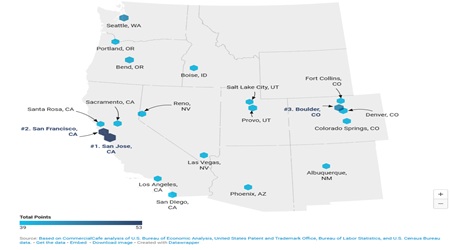
Top 20 TechPHOENIX, ARIZONA (July 8, 2026) — Metro Phoenix ranked No. 14 among the top 20 Western technology metros in a new CommercialCafe analysis of tech industry strength, workforce conditions and innovation activity.

Phoenix earned 31.50 points overall in the study, which evaluated Western metros with populations above 200,000 using metrics that included tech establishment density and growth, tech employment, earnings, quality-of-life factors, and patent activity. CommercialCafe reported that Phoenix added the most tech firms in raw numbers, with tech establishments increasing 11.5% between 2019 and 2023.

The metro also showed strength in innovation output. Phoenix ranked seventh for the number of organizations contributing to tech patent activity, with 365 organizations, and eighth for tech patents granted, with 2,627 patents recorded during the five-year period.

CommercialCafe also reported Phoenix had a tech establishment density of roughly 22 companies per 1,000 residents, underscoring the region’s expanding role as a technology and advanced industry market in the West.

The report reflects Phoenix’s continued growth as a business and innovation center, supported by semiconductor investment, advanced manufacturing, aerospace, financial technology, healthcare technology and a growing base of startups and established technology employers.

The full CommercialCafe report is available here.


Backing Ranchers Should Not Mean Pushing Out Wild Horses

Wild Horses

An outdoor recreation economy also puts food on tables. 

(July 8, 2026) — The U.S. Small Business Administration’s recent promotion of ranchers as the people who “put food on our tables” may sound harmless at first. Ranchers are business owners. Many are family operators. Rural economies matter. But in Arizona, where the future of the Salt River wild horses is under direct threat, this kind of federal messaging lands very differently.

When government agencies elevate ranching interests while wild horses are being labeled as a problem, the public has reason to ask: whose interests are really being served?

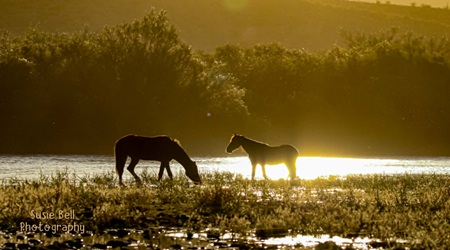
The Salt River horses are not merely an inconvenience on public land. They are protected under Arizona law. They are part of the cultural identity of the Lower Salt River. They draw visitors, photographers, families, outfitters, conservationists, and tourists. They support an outdoor recreation economy that also puts food on tables, fills gas tanks, books hotel rooms, supports guides, and brings people to Arizona.

Yet the public is being told this herd should be reduced to a dangerously low number. AZDA is managing toward 125 horses within five years, despite scientific guidance showing that wild horse herds need larger numbers to remain genetically viable. Even the U.S. Senate, in passing the Theodore Roosevelt National Park Wild Horses Protection Act, recognized a minimum herd range of 150 to 200 horses for that park’s herd.

That is why SBA’s pro-ranching message feels like more than a business promotion. It comes in a broader political environment where ranchers and livestock interests are often given the benefit of the doubt, while wild horses are treated as competitors for land, forage, and water.

Arizona’s wild horses should not be managed out of the way for cattle. Public lands belong to the public, and the Salt River horses belong in the conversation as a protected herd, not as a nuisance blocking another industry’s expansion.

Supporting ranchers does not require sacrificing wild horses. Rural investment, food production, and small-business support can all exist without turning protected horses into scapegoats. But when federal agencies promote one side of the land-use debate while removals are being considered, transparency becomes essential.

Before a single Salt River horse is removed, Arizona officials should answer the most important question: Is the state managing this herd for long-term protection, or is it managing the horses down to make room for other interests?

The public deserves to know.


Registration open for Parks & Recreation after-school summer programs

Parks & Recreation

PIMA COUNTY (July 8, 2026) – Registration is open for two Pima County Parks & Recreation programs that begin in August for grade school and middle school students.

The After-School Program is for children ages 5-12. Activities include a reading program, sports, arts and crafts, board games, and homework help.

Days and times vary by center, but the program will run from school dismissal until 6 p.m. at most locations. There is a $50 fee per child per month, and discounts are available for additional children in the same family.

The Next Level Teen Program is open to children ages 11 to 14. Activities include sports, arts and crafts, and leadership development. All sessions run 2-6 p.m. The cost is $50 per child for the full five-month program.

Both programs will be held at these community centers:

  • Catalina Community Center, 16562 N. Oracle Road
  • Drexel Heights Community Center, 5220 S. San Joaquin Ave.
  • Ellie Towne Flowing Wells Community Center, 1660 W. Ruthrauff Road
  • Littletown Community Center, 6465 S. Craycroft Road
  • Picture Rocks Community Center, 5615 N. Sanders Road
  • Robles Ranch Community Center, 16150 W. Ajo Hwy

“These programs are designed to give grade school and middle school children an engaging and educational experience,” said Parks & Recreation Community Engagement Coordinator Anissa Ramirez. “We’re looking forward to providing a safe, inclusive space where young people can build some wonderful memories this summer.”

Registration will remain open until both programs are full. Register online.