Pima County helps open doors for JPMorganChase remote jobs
TUCSON, AZ (May 26, 2026) — When JPMorganChase was scouting for locations to expand its virtual call centers, it reached out to Pima County’s Community & Workforce Development Department (CWD), which knows a good opportunity when it sees one.
Gabriel Lopez, a CWD program manager who oversees Business Services, knew the region was facing competition from cities in other states to be the call center hub. Connecting employers with Pima County’s talent pool is part of the department’s core mission.
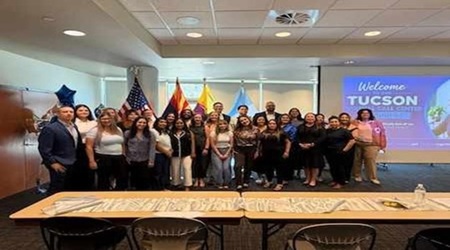
With the support of Pima County Community & Workforce Development, JPMorganChase celebrated the launch of its virtual call center and the graduation of its first County cohort on May 12.
In this case, CWD showed the request and Southern Arizona’s workforce were a perfect match for the scale the company needed.
Need bilingual speakers? Pima County can definitely help. Looking for military spouses? CWD’s Kino Veterans Workforce Center already works with military spouses to provide employment and other support services.
“What really sold JPMorgan was that we have a very heavy bilingual population and we don’t have that many roles working from home,” Lopez said.
“We showed them there was a strong demand, especially among military spouses. Most of them have children and it’s not easy to go outside the home for work, especially after they have just moved to Pima County. We told them we’d have no trouble filling those jobs.”
Mission accomplished.
CWD’s Business Services leveraged its networks to recruit candidates through email outreach and referrals from its case managers at the One-Stop, which regularly connects job seekers with resources, training, and opportunities.
With the support of CWD, JPMorganChase celebrated the launch of its virtual call center and the graduation of its first Pima County cohort on May 12. The company trained and hired 32 local employees — 14 military spouses and 18 bilingual workers — for full-time, work-from-home, customer service jobs.
Pima County joins Detroit, Atlanta, and Baltimore as hubs for the company’s virtual call centers.
“We were lucky to have the Pima County One-Stop team here,” Shannon Warner, Chief Operating Officer for Chase Business Banking, said at the May 12 event.
The 32 jobs are just the beginning. JPMorganChase plans to hire additional bilingual employees and military spouses later in the year, expanding the local team to about 80. While bilingual representatives will remain based in the Tucson area, military spouses will be able to keep their jobs even if their families relocate to another duty station.
That flexibility appealed to Kayla Woods, a military spouse who previously served at Davis-Monthan Air Force Base and later returned to Tucson.
“We had just moved back to the area, and it’s a struggle to find jobs with all the moving around,” she said.
“It looks really choppy on a resume and it’s not apparent right off the bat that we’re military. Employers just might see someone who doesn’t look reliable or consistent. A lot of spouses have such a variety of jobs because it’s hard to find something stable.
“Now, this is so reassuring,” Woods continued. “It’s such a relief to know I never have to find another job again. I can actually keep this job forever. Being a military family is stressful enough, so a career is not something I have to worry about anymore.”
Mitzi Cadena-Varela, one of the new bilingual representatives, said the position provides work-life balance and a sense of career purpose.
“I’m grateful that I found it,” she said. “And I know how important it is to have bilingual talent in an organization. Connecting with a customer in their preferred language not only helps improve purpose but also strengthens trust.”
Lopez said he was always confident CWD could help create a strong pipeline of talent for JPMorgan Chase to put jobs in the local workforce — and the response from job seekers proved it.
“When we started talking to our clients and other people about this position, they almost didn’t believe it,” he said. “They were like, ‘No, this is too good to be true.’”