Raytheon’s New Army Training Rocket The DeepStrike JR3 Passes Third Flight Test in Yuma
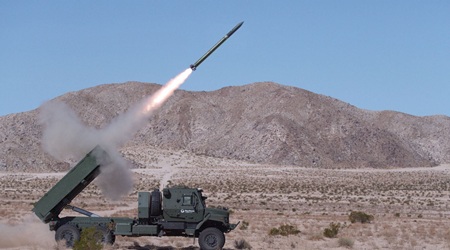 The DeepStrike JR3 is designed to replace the Army’s current practice rocket and reduce training costs with a reusable launch pod.
TUCSON, Ariz. (Nov. 12, 2026) — Raytheon, the RTX business that manufactures missiles in Tucson, has completed a third successful flight test of its DeepStrike JR3 training rocket at the U.S. Army’s Yuma Proving Ground. RTX announced the results Nov. 9, marking another step toward replacing the Army’s Reduced Range Practice Rocket.
Raytheon fired several rounds in rapid succession during the test. The company said it evaluated how far the rockets traveled, how closely they followed the intended flight path and how accurately they struck. The test also assessed how clearly crews could see the impact markers and how easily the launch pod could be reused and maintained. The system is designed to hold 24 rockets in a pod from the Army’s existing Multiple Launch Rocket System Family of Munitions.
“DeepStrike JR3 meets the performance the Army expects from a training rocket while driving down cost and complexity,” said Brian Burton, Raytheon’s vice president of Precision Fires & Maneuver.
Raytheon developed the rocket through a rapid prototyping effort and brought in Combined Systems Inc., Corvid Technologies, L3Harris Technologies, Northrop Grumman and the Army’s Letterkenny Munitions Center. RTX said the team is using commercially available technology to shorten production timelines and lower costs. Raytheon plans additional flight tests to demonstrate the design’s maturity before formal qualification.
Raytheon expands missile production
The Yuma test comes as Raytheon expands production under the Pentagon’s Arsenal of Freedom initiative, which aims to increase munitions output and shorten delivery times. RTX’s October quarterly filing disclosed four preliminary contract awards with potential values of up to $24.4 billion for the Standard Missile 6, about $23 billion for Tomahawk cruise missiles, $20.7 billion for Advanced Medium Range Air to Air Missiles, known as AMRAAMs, and $6.3 billion for Standard Missile 3 Block IB interceptors. Funding depends on annual congressional appropriations.
RTX said it nearly doubled AMRAAM output in 2025 compared with 2024. The company has identified Tucson as one of three production locations for the broader munitions effort, alongside Huntsville, Alabama, and Andover, Massachusetts. The Chamber of Southern Arizona reports that Raytheon employs more than 13,500 people in the region and has committed to adding at least 1,500 jobs as it expands local manufacturing.