Raytheon Tops Arizona Manufacturing List, Reinforcing Tucson’s Defense-Industry Clout
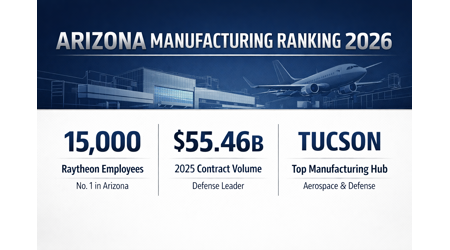 TUCSON (April 10, 2026) — Arizona’s manufacturing story is often told through semiconductors, electric vehicles, and the industrial growth of metro Phoenix. But it may come as a surprise to many that the state’s largest manufacturer is actually in Tucson. The latest Phoenix Business Journal ranking is a reminder that Southern Arizona still holds one of the most important positions in Arizona’s industrial economy and that its influence remains closely tied to a single company.
At the top of the 2026 list is Raytheon’s Tucson operation, ranked as the largest manufacturer in Arizona by employee count. With 15,000 employees in Arizona, Raytheon led the statewide list ahead of Intel in Chandler, which reported 9,600 employees. The ranking is significant not only because of Raytheon’s size, but because it reinforces Tucson’s role as home to one of Arizona’s most consequential industrial operations.
For Southern Arizona, the ranking is more than a point of civic pride. It highlights the way Tucson’s manufacturing identity is concentrated in a single, highly specialized employer whose reach extends far beyond its campus. While metro Phoenix dominates much of the current conversation around industrial growth, advanced manufacturing investment, and supply chain expansion, Tucson continues to anchor one of the state’s deepest concentrations of aerospace and defense production.
That distinction matters. Raytheon’s scale in Tucson supports a manufacturing ecosystem distinct from the warehouse-heavy or distribution-led growth often seen elsewhere in Arizona. The company’s local presence is tied to high-value production, engineering, systems development, testing, research, and skilled technical employment. This is not simply a large employer occupying industrial space. It is a foundational operation that helps define a regional business cluster.
Tucson has long benefited from that positioning. Aerospace and defense have been central to the region’s economic identity for decades, shaping everything from labor force specialization to supplier networks and educational partnerships. Raytheon’s continued prominence reinforces that legacy while also signaling that Tucson remains competitive in one of the most strategically important corners of U.S. manufacturing.
The ranking also reveals an important truth about Southern Arizona’s industrial profile: Tucson’s manufacturing presence is not built on a long list of similarly scaled employers. It is anchored, decisively, by Raytheon. With the next Tucson manufacturer appearing much farther down the statewide list, the implication is clear. Tucson’s place in Arizona manufacturing remains substantial, but it is concentrated. Raytheon is not just one of several large manufacturers lifting the region’s numbers. It is the company that defines the category locally.
That concentration creates both strength and visibility. Raytheon’s scale in Tucson is reflected not only in employment, but in the volume of defense work continuing to flow through its missile manufacturing operations. The Tucson-based business secured major awards in 2025, and recent contract activity suggests that momentum is continuing into 2026.
On March 18, the U.S. Missile Defense Agency awarded Raytheon an $8.41 billion contract modification tied to Standard Missile-3 work, raising the ceiling of an original 2020 contract from $3.33 billion to more than $11.74 billion. The award covers support services for Standard Missile-3 Block missile variants for the United States and foreign partners, with work scheduled to continue through October 29, 2029. While the contract includes work in Alabama, a significant share will be performed at Raytheon’s Tucson operation, reinforcing Southern Arizona’s role in one of the nation’s most important defense manufacturing programs.
That was not the company’s only recent win. Raytheon also received a separate $266.9 million contract modification for Standard Missile-3 Block IB production, bringing the total value of that 2024 award to more than $1.365 billion. In another recent action, the U.S. Navy awarded Raytheon $10.76 million to exercise options related to the rolling airframe missile, with all work under that award to be performed in Tucson through March 2028.
The broader picture is notable. According to research from the Phoenix Business Journal, Raytheon secured $55.46 billion in contracts during fiscal 2025, making it the contract leader among Arizona defense contractors. That volume helps explain why Tucson remains so important to Arizona’s manufacturing economy. Raytheon is not simply a large employer based here. It is a production platform tied to some of the country’s most consequential missile and defense systems, and that translates into jobs, supplier demand, industrial investment, and long-term relevance for the region.
That standing has broader real estate implications as well. Large, advanced manufacturers shape demand differently than conventional industrial users. They influence land planning, infrastructure, talent pipelines, transportation networks, and the long-term appeal of a market to complementary employers. In that sense, Raytheon’s footprint extends beyond direct employment. It reinforces the institutional and economic framework that makes Tucson viable for other users in technology, aerospace, and precision manufacturing.
At the same time, the ranking underscores the importance of growing the bench behind the leader. A market anchored by a single dominant manufacturer has a powerful economic engine but also a clear incentive to deepen the surrounding ecosystem. That means continuing to attract suppliers, smaller advanced manufacturers, research-based firms, defense-adjacent users, and specialized industrial operations that can build on Tucson’s existing strengths.
The broader Phoenix Business Journal list reflects the scale of Arizona’s manufacturing economy. The publication reported that the 75 largest manufacturing firms in the state employ more than 1 million people globally and more than 63,000 in Arizona. For Tucson, the takeaway is validation and opportunity. Raytheon’s No. 1 ranking is not just a list item. It is a signal that Tucson remains one of Arizona’s manufacturing centers, shaping the statewide conversation.