PHOENIX OFFICE MARKET POSTS ALMOST TWO MSF NET ABSORPTION IN 2013

Courtesy photo
Courtesy photo

PHOENIX, Ariz.– Cushman & Wakefield reports the Metro Phoenix office real estate market posted just under two-million-square-feet of positive direct net absorption in 2013, outpacing activity of five of the past six years, according to the year end report released Tuesday by Cushman & Wakefield of Arizona, Inc.

The Metro Phoenix office market posted net absorption of 1,955,355 square feet in 2013, compared to net absorption totaling 2,217,348 square feet in 2012. The best-performing office submarkets were the Scottsdale Airpark with 461,616 SF, the Camelback Corridor with 389,394 SF, and Tempe with 385,306 SF of positive net absorption.

Those three submarkets collectively posted 1.236 million-square-feet of positive net absorption, which translated to 63 percent of the entire Metro Phoenix market activity for 2013. Top of market rental rates  in each of these submarkets exceeded  $30 per square foot.

“Two consecutive years of solid net absorption have helped decrease the overall vacancy rate in the Phoenix office market,”  said Jerry Noble of Cushman & Wakefield’s Office Properties Group. “We continue to see improved activity on the street, and there are several large office requirements in the market.   Tech and insurance companies have been significant drivers of demand.  We expect 2014 to be another good year.”

Notable Metro Phoenix office sales included 111 W. Rio Salado Parkway, Tempe, $41.765M; 4343 N. Scottsdale Road, Scottsdale, $68.6M; and 6811 E. Mayo Blvd., Scottsdale, $38.6M. Notable Metro Phoenix office leases included 15111 N. Pima Road., Scottsdale, 148,732 SF; 16260 N. 71st Street, Scottsdale, 121,123 SF; and 60 E. Rio Salado Parkway, Tempe, 85,000 SF.

The Metro Phoenix office market vacancy rate decreased as well in 2013. The direct vacancy rate fell from 23.0 percent at year-end 2012 to 20.8 percent at the end of 2013.

The lowest direct vacancy rates in 2013 were posted in North Tempe and South Scottsdale at 6.9 percent and 12.8 percent, respectively.

The direct average asking rental rate for office space in Metro Phoenix increased year-over-year from $20.25 per square foot in 2012 to $20.60 per square foot in 2013.

Looking ahead to 2014, the most active construction will continue in the Tempe submarket as Marina Heights (the State Farm Insurance campus) and Hayden Ferry Lakeside III come out of the ground.

“Scottsdale, Tempe, and Camelback are rapidly improving,” said Noble, who added that properties along the Loop 101 are some of the more sought after in the Valley. “The real story line for 2014 is already underway.  With very little new construction underway, tenants seeking efficient large blocks of space in these areas have limited options available. This will drive rents, help support new construction, and also drive activity to other submarkets.  Rents in these pockets have already increased and will continue to do so.  It has been over 10 years since tenants have been forced to look for space more than a year in advance of their target occupancy dates due to limited supply.”

Click the link for Phoenix office stats: PHX OFC 4Q13 SUMMARY



June Unemployment Numbers – Seasonal vs Unadjusted – So Where Are the Jobs?

work-job-huntArizona released job numbers last week. After four months below 8.0%, Arizona’s seasonally adjusted unemployment rate inched up two-tenth of percentage point from 7.8% in May to 8.0% in June. Compared to the US adjusted unemployment rate that remained at 7.6%.

The unofficial, “unadjusted for seasonal work” numbers per Arizona counties are more alarming, showing a jump of one percentage point, from 7.1% to 8.1% month over month. When Native Americans are included in the unadjusted report, the unemployment goes from 7.4% in May to 8.5% in June.

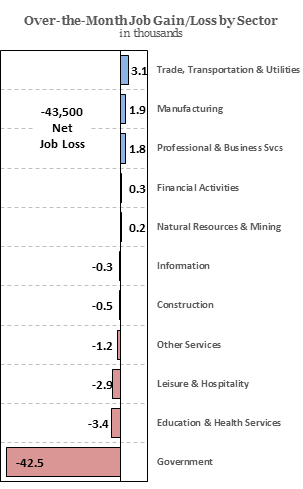
Arizona reported a net loss of 43,500 nonfarm jobs (-1.7%) in June. This loss is comparable to the ten-year average (2003-2012) loss of 41,700 jobs. The majority of nonfarm job losses were reported within Government, which lost 42,500 jobs (-10.2%). These losses are typical this time of the year due to scaling back in employment for summer within Local (-34,800 jobs) and State (-11,100 jobs) and Public Education. The Private Sector lost 1,000 jobs, less than the ten-year-average (2003-2012) a loss of 4,000 jobs. Five of the eleven major sectors added jobs, while six reported losses.

Job growth sectors June 2013Arizona reported Tucson’s unemployment rate for June also at 8.1%, based on the most recent statistics from The Office of Employment and Population Statistics (EPS) as of July 18, 2013. Tucson’s overall labor force was reported to be 245,125, with 225,335 employed, and 19,790 unemployed or an 8.1% rate of unemployment for June, up from 6.8% in May. The overall labor force of Tucson had decreased by 4,242 since the start of the year.

The current overall labor force for Pima County in June 2013 was reported to be 454,070, employment at 419,802, and unemployment at 34,268. An increase for Pima County from 6.3% to 7.5% month over month. The overall labor force in Pima County had decreased 7,685 since January 2013.

Tucson lags behind the other Towns in the area, although all had increased unemployment rates. Overall labor force in Marana is at 16,249 with 1,103 unemployed, or a 6.8% unemployment rate. Oro Valley’s labor force is at 17,926 with 1,134 unemployed, or a 6.3% unemployment rate and Sahuarita with an overall labor force of 11,665 has 745 unemployed, or a 6.5% unemployment rate.

So where are the jobs? Statewide, over the month, Trade, Transportation and Utilities reported the largest gain of 3,100 jobs (0.6%). The main driver within TTU was larger-than-average gains in Wholesale Trade (2,800 jobs). Manufacturing reported gains of 1,900 jobs, above the historical average and primarily from gains in Durable Goods (1,700 jobs). Professional and Business Services (1,800 jobs) and Financial Activities (300 jobs) also reported job gains. Besides Government, which recorded the largest job loss, Education and Health Services also lost 3,400 jobs (0.9%); the majority of these losses were from Educational Services (-4,300 jobs). Other sectors with job losses included Leisure and Hospitality (-2,900 jobs), Other Services (-1,200 jobs), Construction (-500 jobs) and Information (-300 jobs).

Arizona gained 49,400 nonfarm jobs (2.0%) compared to a year ago in June. The Private Sector added 54,300 jobs over the year, growing by 2.7%. This is the 23rd consecutive month of at or above 2.0% growth in the Private Sector. Government shed 4,900 jobs (-1.3%), ending thirteen consecutive months of positive over-the-year job growth. Nine of the eleven major sectors reported gains with two reporting losses. The largest over-the-year gain occurred in Leisure and Hospitality (12,500 jobs). Construction recorded the second largest gain (7,900 jobs), and has posted growth rates at or above 5.0% for eleven consecutive months. Other major sectors reporting gains include: Trade, Transportation and Utilities (9,200 jobs), Professional and Business Services (8,000 jobs), Education and Health Services (7,300 jobs), Financial Activities (7,200 jobs), Manufacturing (1,200 jobs), Information (1,000 jobs), and Natural Resources and Mining (400 jobs). Government lost 4,900 jobs; the majority of these losses occurring in Local Education (-6,600 jobs). Other Services also reported over-the-year losses (-2,400 jobs).

Get detailed information on Arizona data at www.azstats.gov


SCOTUS Defends Property Rights Against “Unconstitutional Conditions”

US_Supreme_Court[1]While most of the media is focused on the Supreme Court’s rulings on voters’ rights and affirmative action, yesterday in a 5-4 vote, the U.S. Supreme Court (“SCOTUS”) issued its opinion in Koonz v. St. Johns River Water Management District, No. 11-1447, slip op., 570 U.S. ___ (2013).  Koontz, a victory for the property owner, is an important property rights case affecting the government’s ability to impose monetary conditions on the approval of land use permits. 

The case arose when Coy Koontz sought permits to build on approximately four of his nearly 15 acres in Florida, much of which Florida classified as wetlands.  Koontz needed special permits from Florida’s water management district (“WMD”) in order to build, which could include conditions to mitigate the impact on the wetlands.  When Mr. Koontz applied, he offered to give the WMD a conservation easement over the remaining 11 acres of his property to restrict their development.  The WMD, rejecting his offer, gave him two options: (i) reduce the size of his development to one acre and give the WMD a conservation easement over the remaining 14 acres; or (ii) pay the costs of construction improvements, including replacing drainage culverts and filling ditches, to the WMD’s off-site wetlands several miles from Koontz’s property.  The WMD denied his permit when Koontz refused these options.

The Koontz case raises two important legal issues under the so-called “unconstitutional conditions” corner of regulatory takings law: 1) whether the Nollan/Dolan standard, which requires that government-imposed project conditions have a nexus to and rough proportionality with the projected effects of a proposed project, applies to project denials as well as project approvals; and 2) if the Nollan/Dolan test applies to monetary exactions as well as government’s compelled dedications of real property.

Koontz answered two questions.  First, the Supreme Court held the Nollan and Dolan analysis applies whether the government approves a permit with the unconstitutional condition or denies the permit because an applicant refuses to accept the unconstitutional condition.  This holding gives landowners bargaining power, because property owners do not need to accept “extortionist” conditions before they can challenge their validity and seek just compensation.  Second, the Supreme Court held that “‘monetary exactions’ must satisfy the nexus and rough proportionality requirements of Nollan and Dolan.”  In this sense, monetary exactions from landowners are treated no differently than conditions requiring a landowner to give the government an interest in their land.  Unless the requirement to pay money has a nexus with property and is roughly proportional to the development’s expected impacts, the requirement will be found unconstitutional.

To view the entire case go to https://www.supremecourt.gov/opinions/12pdf/11-1447_6j37.pdf