Lot Supply a Bigger Worry than Labor or Lending to Home Builders

Builder News is reporting that home builders worry about the lot supply in many markets lagging behind demand. Municipalities’ failure to keep pace with their processes makes penciling in the next 24 to 36 months’ land strategy a big challenge.

Lot supply is a bigger worry than labor or lending availability right now. It makes sense that if you can’t get home sites, the other two issues shrink measurably as headaches to builders.

A big reason builders and developers give for land coming online so slowly is human bandwidth, and not just their own. The post-Great Recession cutback in local and regional government officials, engineers, planners, inspectors, even clerks, has ground the process in many of those localities to a trickle. Projects logjam while there’s too few municipal personnel qualified to green-light them for a next stage of development, evaluation, and approval.

If you’re a local builder or broker experiencing these problems, we would like it hear from you. Please contact us at [email protected]

For the full story click here.


A Year of Growth in Tucson for Home Building

Strong permits, house starts and land development add to an improved economic outlook

TUCSON, Arizona — The year 2016 was a good one for the Tucson home building market and for Tucson in general. The Great Recession took its toll on Tucson and attitudes regarding the economy and future growth were often negative for many years. It seemed jobs and growth were passing us by in favor of larger markets, including Phoenix just to our north. The housing market began its turnaround in 2012 but it was slow. The driving force of the housing rebound was the move-up markets, particularly in the Northwest submarket. While the higher prices and increased sales were welcomed, there was also an underlying concern of the sustainability and depth of this move-up market in Tucson where the median household income is only $46,162 (per US Census). The lack of high paying jobs was always a point of discussion.

In 2016 things began to change. In March, Banner Health announced that it had allocated $500 million for capital improvements in Tucson which would result in significant construction and other related jobs. Home Goods purchased land to construct a distribution center and announced in April that it would be looking to hire 400 employees initially and then increasing that number to 900 in subsequent years. Then in May, Caterpillar announced that it would be relocating its Surface, Mining & Technology Division to downtown Tucson. They estimated this would bring in 600 executive level jobs within the next five years. The biotech company Monsanto purchased 155 acres in Marana in October and plans to employ 50 initially but the operations may expand to employ much more. Raytheon announced in November that they plan to expand in Tucson and hire an additional 2,000 employees over the next five years. That same month Lucid Motors announced plans to construct a plant in Casa Grand to assemble electric cars. It hopes to employ 2,000 workers and be at full capacity within six years.

The impact of the employment and economic benefit of these future jobs is significant. An additional benefit that is hard to quantify is the number of supporting vendors and businesses that will follow these larger corporations to Tucson. With these job announcements attitudes regarding the economic outlook of Tucson are now extremely positive, a near 180 from just a year ago. This optimism is spreading through the home building industry as now they can more easily identify future demand for housing.

The builders and developers deserve credit for exercising their faith in the future growth and strength of the Tucson market as 620 permits were pulled in Q1. This was 80 more than Q4 2015 and 150 more than Q1 2015. In Q2 there were 750 single family permits pulled. This was followed up with 622 and 667 in Quarters 3 and 4 respectively, for an annual total of 2,699 permits, a 24% (523 permit) increase over 2015.

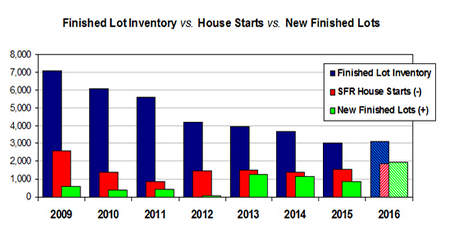
Builders have been working hard to fill their pipelines with lot inventory over the past few years primarily with platted lot purchases. These lots began to enter the market in significant numbers in 2016 with 1,953 new lots being completed. This is a roughly the same number as the prior two years combined when 873 and 1,139 lots were brought to market. It will be crucial to maintain or increase this pace of development to meet the demands of the improving market.

One negative aspect of the year related to land was a significant drop in the value of land transactions and correlated lots. In 2016 the total value of the 49 single family related land purchases was $64.9 million with 1,474 lots. This is considerably lower than the prior four years:

2015: $118.8 million / 3,766 lots*
2014: $108.6 million / 2,457 lots*
2013: $127.1 million / 4,765 lots*
2012: $ 97.4 million / 2,362 lots*

* lot numbers are approximate as some raw or block platted land deals did not have lot counts associated with them. Once entitled, these lot counts will increase.

Each of the prior four years had at least one extraordinary purchase, which 2016 lacked. While this lower number of lots purchased should not impact 2017, it may start to impact 2018 and beyond if builders and investors do not increase their land purchases and lot development going forward. The current strong economic outlook should bolster confidence and we should see more deals being done this next year. We are excited for the Tucson land market as we begin the new year in 2017.

* Permit data from Bright Future Real Estate Research, LLC and Sales comp data from RED Comps a division of Real Estate Daily News Comps (realestatedaily-news.com)

For the full report click here.  To learn more Aaron Mendenhall can be reached at 520.747.4000 x102 for additional insight and information.


Land and real estate markets “at the Crossroads” 2016

lots sales 450x250Reprint from November TAR Scorecard

By all accounts, 2016 will be a pivotal year for housing. For developers, their land deals will set the pace for new home construction over the next two to five years. For the resale market, there are still too many distressed properties.

“We do not have the luxury of a big lot supply going forward. That is the biggest challenge in the new housing market. Even if we stay flat, we basically need 2,500 lots per year,” said Will White, Land Advisors’ Tucson manager. “So we are at a crossroads, realizing that new lots could go negative in 2017.”

“Remember, the Tucson region went to negative job growth for an extended period. For 2016, we’re looking at 1.4% job growth, and 2% for 2017 to 2019,” added Ginger Kneup, Bright Future Real Estate Research. “The economic forces to bring developers back into the market are all coming together next year. The question is will they be proactive or reactive?”

Kneup and White presented their annual forecast this month called 2016 At the Crossroads. The future of the Tucson land and housing market. They focused on housing supply – demand concerns and how that imbalance will affect the market.

Since 1995, the region has absorbed an average 27,000 lots every 5 years, said White. To keep pace, builders face three major decisions. In undeveloped sectors, infrastructure is lacking and expensive. Once land is acquired, it can take up to 24 months to get a house to market. Sunk costs are rising or land, regulatory fees, materials and labor. And market share is maintained only by getting more land.

“To start a new community from scratch will be a challenge. So do builders buy land now or later? In this market, five builders do 80% of the business,” said White. “Where will they find inventory? For a community of one million population, there are very limited growth opportunities.”

From the demand-side perspective, Kneup emphasized that foreclosures and resales overall need to “get healthy. Distress continues to hold back the market.” Distressed sales have a 14% market share, down about 5% annually. The normal level should be in the range of 3.5%, Kneup said.

For the last five years, new home market share has been stuck at about 10%.

Builders have had great success in the move – up market, yet prices are a 40% to 50% premium over resale. To capture more sales, builders could re-evaluate their designs. Can they replicate their success in the move -up market at a lower price point?

“What they have control over is product: innovative, flexible multi-gene ration floorplans. Millennials put off home ownership but if you deliver more relevant product for that generation, it will get Millennials excited about buying,” she said.

“That is the biggest challenge, not easy to deliver. Can we build what they want where they want at the right price?”

Click here for full November TAR Scorecard