Rio Nuevo Board Gives the Nod to HSL on Tucson Convention Center Hotel
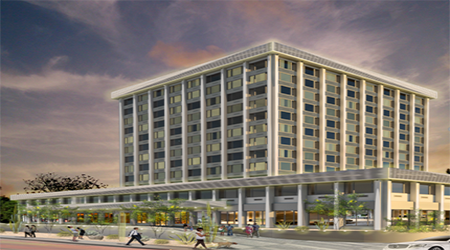
Tucson Convention Center Hotel rendering (courtesy photo Swain & Associates)

TUCSON, ARIZONA — The Rio Nuevo Board of Directors took steps Tuesday to advance a Convention Center Hotel by un-shuttering the 300-room Hotel Arizona. The 13-story, 155,179-square-foot hotel sits on 3.56-acres with a stand-alone parking structure connected via skywalks at Congress / Broadway and Granada, adjacent to Tucson Convention Center (TCC), in Downtown Tucson

After a feasibility study was conducted by HVS to determine the hotel market conditions in downtown Tucson, the project had lots of support including Brent DeRadd, CEO for Visit Tucson, Glenn Grabski, GM for the Tucson Convention Center, and Bob Hoffman with the Tucson Roadrunners.  All made strong statements in support of the project.  Even a competitor spoke during the call to the audience, Brian Corbell from The Riverpark Inn spoke in full support of the convention center hotel coming back downtown.
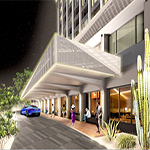
Tucson Convention Center Hotel rendering (courtesy photo Swain & Associates)

The Hotel Arizona was built in conjunction with the Tucson Convention Center in the early 1970s and served as Downtown Tucson’s primary convention lodging facility until its closure in 2012. The hotel originally opened as Braniff Place and over the years has been branded as a Marriott and a Holiday Inn. The hotel is now expected to undergo an extensive renovation and modernization to reopen as a DoubleTree by Hilton, or similar brand, once again providing the Downtown with a large convention-oriented lodging facility.

The hotel is expected to include a fully renovated signature restaurant and a three-meal restaurant, as well as a lobby bar and lounge and banquet operations.

Other fully renovated amenities are expected to include a full-service business center with various workstations, a gift shop (featuring a grab-n-go market), wireless Internet access in the public areas, and possible retail boutiques.

The Architect is Swain and Associates of Tucson, the same architectural firm for the AC Tucson Hotel.

The Rio Nuevo Multipurpose District will allow the developer to recapture the Rio Nuevo Site Specific TPT taxes through 2025 and structure a GPLET for the property for up to 25 years.  The developer will spend $20 million to renovate the property.

Plans are to have it open by January 2019, in time for the Gem Show.

Edmund Marquez, a Rio Nuevo Board member, who made the motion to move forward said, “The redeveloped hotel is an opportunity to serve an under-served niche in the market. Based on other communities the size of Tucson, the downtown area is under-served for hotel rooms and that affects the TCC use. Despite current hotel projects underway, there is still greater opportunity downtown for lodging.”

Convention centers generate significant levels of demand for area hotels and serve as a focal point for community activity. Typically, hotels with the closest proximity to a convention center – up to three miles away – benefit the most. The 205,000-square-foot TCC has three Exhibition Halls that can share a total space of 89,760-square-feet. In 2015, the TCC underwent an $8 million renovation that included new seating, updated concession stands and new sound and visual aids. TCC also underwent management change when SMG took on the day-to-day operations from the City.

Last year, TCC become home to the Tucson Roadrunners, a new franchise and affiliate of the Arizona Coyotes.

According to Mark Irvin, Secretary of the Rio Nuevo Board, “By my count, Rio Nuevo has helped create close to 700-rooms downtown. There are 139-rooms opening this year at the AC Marriott, 109-rooms in due diligence phase at the Moxy Hotel, 125-rooms at Caliber Hotel and now 300-rooms more when HSL Hilton can be unshuttered. By working closely with the developers and using the arrows in Rio Nuevo’s quiver wisely, we have been able to make it happen.”

The project will now go to the City for GPLET approval.


ULI Panel: Give Free Market a Chance Tucson (Part 1 of 2)

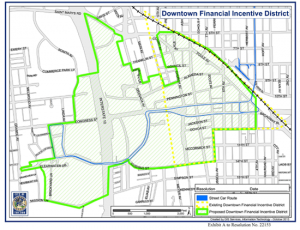
District Map studied by Urban Land Institute Panel

The Urban Land Institute (ULI) advisory panel presented their findings to a room of about 200 people at the Tucson Convention Center on Friday. The ULI panel consisted of seven independent volunteers from real estate and related disciplines who were commissioned to address such issues as: market forces, best land use, retail, quality of life issues, and implementation for Downtown Tucson development. The panel interviewed 150 people during their week-long stay in Tucson.

The candid and unbiased input from these professionals was summarized in their report that stressed the importance of prioritizing projects, taking small steps towards long-term goals, while creating synergy within the community and leveraging limited public resources to encourage private sector investment.

The study area as shown in the map included the panel focusing on downtown Tucson, the TIF District, the Streetcar route and east and west side of I-10 in this area.

Market Forces

John Walsh, of the ULI panel, spoke about how there has been an anemic economic recovery from the Great Recession and Tucson’s has been even more anemic than others. He did predict however, that Tucson will probably be outperforming the national recovery by 2015.

The downtown hub consists of government, culture, entertainment, and cutting edge food and beverages. Office space other than government is currently 80% outside of the downtown, this can be expected to change as the district grows its attractiveness to businesses.

National and local trends indicate a move towards more urban lifestyles. The conclusion of the panel was that Tucson downtown could use an additional 200-300 rental units per year. SFR development should be encouraged for infill projects surrounding historic neighborhoods and development on the west side.

Market forces show office vacancy will be the last to recover, with mostly class B and C office space in the downtown, these should be leased before new office construction. The new co-worker space and a small to midsize (100-200 room) hotel would support the government, business and event traffic of the district, such as the hotel currently under discussion.

Retail Trade Area

Urban retail is normally the first to comeback to a district and this helps with the perceptions the district.

Demographics of district in the study:

  • Population: 42,135, 40-50% are estimated to be students, hipsters and lower income Latinos make up the rest of the population.
  • Households in the trade area earning $75K + (1,707)
  • Households earning under $25K (8,152)
  • Home Values over $200K (1,186), partially due to the high density of students in the area.

Daytime workers number about 27,000, with public sector workers being mostly Yupsters, who combine careers with non-mainstream tastes. A concern was raised that supply in restaurants may be outpacing demand in the district, as most of these are targeting the same single customer.

Recommendations from the panel were to focus on smaller retail spaces that would aggregate to larger. A properly scaled Mercado on the west side of I-10 would be appropriate. Modest 8,000 to 12,000-square-feet retail such as The Buffalo Exchange has planned on Congress Street is a good example of the type if retail that will work. Restaurant operators that are “chain-lets” with 2-3 other locations should be sought, such as the World of Beers and Pizzeria Bianco; these help provide distinctiveness to the district.

For risk mitigation, the panel recommended the Ronstadt Transit Center should stay in place and residential density be increased in the district. Retail need density where appropriate and to supplement the density by adding destination uses and activities incrementally.

Tucson Convention Center (TCC)

The checkered history of the convention center hosted only 20 conventions in exhibit hall in 2012, with 455,000 people using the TCC complex for such exhibits as the Gem Show. The TCC complex is an important asset to the City of Tucson for social, military, educational, religious and ethnic events. It currently has capacity that is underutilized and could handle sports events and trade and consumer shows with minor modifications. For instance, to add locker rooms for sport tournaments, and a green room to the arena.

The panel also encouraged private management of the TCC. The TCC stewardship needs to improve, with professional oversight for all venues.

The panel recommended the aesthetics of the ballrooms be improved and that the north meeting room be repurposed to face the theaters.

As for the Hotel Arizona and La Placita, the panel thought the hotel would be best razed for redevelopment, while La Placita could be redeveloped. The Stravenues could be improved at little cost, as well as make the walking paths well-marked and inviting for tourists.

Rather than have La Placita sitting vacant as it is today, it was suggested that the UofA could relocate the School of Architecture, Performing Arts or Visual Arts to La Placita. For more exhibit space needed for the Gem Show, it was suggested to create a “Market Hall” across the street where the tents are today.

For offsite venue, recreation center, neighborhood community center for the west and south side communities, it was recommended that a Kroc Center, YMCA or Rec Center be put next to the fire station. This could include a gym, pool, community rooms and should be built by the non-profit and private sectors.

On the west side, the panel recommended the most economically feasible and best use for the land fill site is for a rodeo and equestrian use. This fits into Tucson’s birthplace and will become “A new heart for Tucson”. It supports further the intent set forth in existing plans for such an historic and cultural facility. A rural arena would be used for infrequent events.

The reporting of this meeting is being done in two parts. Part two on Street Recommendations and Implementation will be continued tomorrow.

Part Two of this report can be read here