Phoenix, Buckeye among biggest-, fastest-growing cities in U.S. in 2017

By Dani Coble |Cronkite News
WASHINGTON – Two Arizona cities were among the fastest-growing in the nation in 2017, according to population estimates released Thursday by the Census Bureau.

The bureau’s “2017 City/Town Population and Housing Unit Estimates” said Phoenix saw the second-biggest increase among cities in nation, adding 65,852 new residents over the course of the year, or almost 66 people per day.

That trailed top-ranked San Antonio by just 172 people – or less than half a new resident a day – and was well ahead of third place Dallas, which added 18,935.

The report also said Buckeye saw the fifth-fastest growth rate in the U.S. last year among cities with more than 50,000 residents. Buckeye added more than 3,800 people, according to Census estimates, a 5.9 percent growth rate that brought its estimated total population to 68,453.

It was a continuation of the boom in population for the town, which posted the seventh-fastest growth among 2016 and has grown more than tenfold since 2000, when there were fewer than 6,000 people living in the city.

“Definitely people are interested,” said David Roddrique, Buckeye’s economic development director.

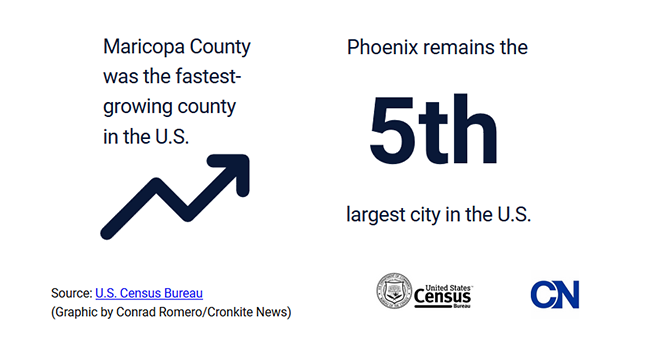
The city rankings come just months after the Census Bureau said Maricopa County had the largest growth among the nation’s counties last year.

Roddrique and other experts in the Valley point to a combination of factors for the continued strong population growth in the region, chief among them jobs and, in Buckeye’s case, room for affordable housing.

Buckeye may be a long commute to most Valley jobs, but Roddrique said the price of homes in the city currently makes it worth the drive.

And commutes for some could get shorter soon: The room to grow and build has started to attract retail and other companies, the most notable being Nikola Motor Co. The electric truck company plans to invest $1 billion in a Buckeye factory that will bring an estimated 2,000 jobs to the area.

Jobs are also the driving factor behind Phoenix’s continued growth, said Eric Jay Toll, spokesman for the city’s Community and Economic Development Department.

“The city of Phoenix has been increasing the number of quality jobs that it offers to its residents,” Toll said Friday.

Accommodating all those new people are new houses. The Census said the nation added more than 1 million homes last year, a 0.8 percent increase. But the number of new homes, and the rate of growth, were both lower for Arizona and for the nation than they were in the pre-recession years of 2006-2007, the bureau said.

But Patrick Lewis, president-elect for the Arizona Association of Realtors, is not convinced the housing numbers are accurate. He said his association is seeing strong numbers and that values are back up to pre-recession numbers.

“Where jobs are people will follow,” Lewis said.

Phoenix’s growth boosted the city’s population to just under 1.63 million people, letting it keep its position as fifth-largest city in the country, behind New York, Los Angeles, Chicago and Houston, and ahead of Philadelphia.

While Buckeye is far removed from those cities, Roddrique is confident the city will be on the list of fastest-growing cities for decades to come.

See the full story here.


BOMA Greater Phoenix rallies behind Prop. 301 extension

PHOENIX, ARIZ. — BOMA Greater Phoenix, which advances commercial real estate through advocacy, influence, and knowledge, was one of two industry groups to register in favor of a Prop. 301 extension of the 0.6 cent state sales tax (TPT) to continue putting more money into Arizona classrooms.

The Arizona Legislature last week passed and sent to Gov. Doug Ducey the Prop. 301 extension that funds K-12 education in Arizona by approximately $600 million per year.

The vote on SB1390 was 53-6 in the House and 26-4 in Senate and was passed in one day. The only significant tweak to existing law is it redirected $64.1 million that was for capital bonding to have that money also go into the classroom (Classroom Site Fund).

“While there were a myriad of groups and individuals that supported this bill including the Arizona Chamber of Commerce and the Arizona Tax Research Association, BOMA (Building Owners and Managers Association) and CREED (Commercial Real-Estate Executives for Economic Development) were the only two commercial real estate groups to register in favor,” said BOMA Greater Phoenix Executive Director Tim Lawless.

The passage was as a legislative bill rather than a referral to the ballot. The Legislature now retains control to make tweaks to the funding buckets on a moving-forward basis. If it had been passed by voters, it would have been Prop.105 protected, which would require supermajorities to amend or further the intent.

“The reason this was wise to support is we are now on official record in support of K-12 education and the expenditure of new resources,” Lawless said. “This will give us credibility and a seat at the table when the discussion now moves to funding sources and an additional $400 million per year that the education lobby will seek by the 2020 ballot.

“While we would not prefer this new funding to be a new statewide property tax, we need to be flexible should this be put on the table so we can pursue greater property tax fairness and equity for all businesses that pay as much into supporting K-12 as everyone else,” Lawless said.


Phoenix 4Q Retail Performance Breaks Records

Vacancy and Absorption Overall Phoenix

The retail market in the Phoenix metro area has improved every year for the past six years.  Slow and steady improvement each year has been recorded providing a bright future for retailers, building owners and investors looking at the Phoenix market.

Since 2012 the vacancy rate in Phoenix has improved 300 bps, with the current vacancy at 8.8%.  Absorption is also strong with 2.25 million square feet leased in 2017.  These indicators, combined with healthy new construction deliveries of 1.7 million square feet make for a trifecta of positive indicators in commercial retail for Phoenix.

In looking ahead to 2018, we project continued steady absorption, new construction that is fueled by tenant demand, and a continued decrease in the vacancy rate.

The Phoenix Regional Submarkets

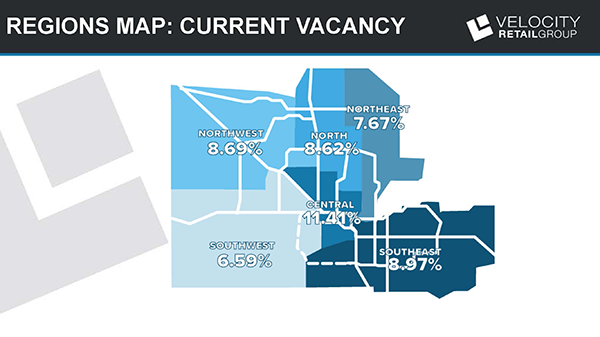
Our research breaks the Metropolitan Phoenix area into six regional submarkets.

During 2017 the Southeast Valley recorded the greatest improvement and is an “All Star” performer in our books.

The Southeast Valley was one of the hardest hit submarkets during the recession. In 2012 the area had a 13.4% vacancy rate.  Fast forward to 2017, currently the area has a vacancy rate of 8.9%, which is a 450 bps improvement.  During 2017 the Southeast Valley also recorded the greatest amount of absorption, totaling nearly 1.3 million square feet.  This was over 57% of the absorption for the entire Phoenix metro market.  No other region came close to recording this amount of absorption.  The Southeast region also captured the greatest amount of new construction activity during 2017, with over 38% of the new space built being within this regions boundary’s.

Another Regional All Star is the Southwest Valley, with a current vacancy rate of 6.6% this is the submarket with the lowest recorded vacancy.  In 2012 the vacancy rate was 9.9%, which is a 330 bps improvement in this time period.  Absorption totaled just over 200,000 square feet, with new construction projects at 208,000 square feet.

Overall, each of the six submarkets improved in vacancy and absorption year over year. With continued strong retailer demand we expect continued progress on all fronts across the Valley.