Real Estate Daily News Contributor, Terri Jo Neff Honored by Arizona Press Club

COCHISE COUNTY — Terri Jo Neff, a freelance journalist based in Cochise County, has been awarded third-place by the Arizona Press Club for community public safety reporting. The award, which was announced June 4, recognized Neff for her reporting for the Cochise County Record in 2016 in the areas of law enforcement, courts, corrections, fire and rescue.

On learning that the Arizona Press Club selected Neff’s work for recognition, Cochise County Record publisher David M. Morgan stated “Terri Jo Neff is the finest reporter I’ve worked with in decades. Her attention to detail and documentation, and her ability to explain serious news concisely, is rare.”

Arizona Press Club winners are usually on-staff reporters, noted Morgan, so Neff’s freelance status demonstrates the judge appreciated “that quality journalism comes in many forms.”  He added that having a freelance reporter like Neff in the community “so dedicated to serious news in a small market and willing to be published by an under-capitalized, non-traditional platform, is even more rare.”

The announcement of Neff’s award included comments by judge Shoshana Walter of the Center for Investigative Reporting that Neff shows “a good command of complicated court filings and proceedings.”  Walter reviewed five of Neff’s articles published last year that, according to the judge, “shed light on abuses of power in the Cochise County criminal justice system.”

“I am honored to have my work recognized by the Arizona Press Club and Ms. Walter,” Neff said upon hearing of her third-place award. “My thanks go out to the Cochise County Record and the other editors who published my work in 2016.”  Those other publications include the Sierra Vista Herald, Willcox Range News, Benson News Sun, Tombstone Gazette, and Real Estate Daily News.

The Arizona Press Club’s community awards recognize journalists who write for daily newspapers with circulation of less than 20,000, non-daily publications with circulation under 50,000, and online-only publications.

First place in the public safety category went to a team from the Arizona Center for Investigative Reporting, while second place was awarded to Paulina Pineda of the Nogales International. Pineda was also named the Press Club’s 2016 community journalist of the year.

The Cochise County Record focuses on serious news -courts, crime, and politics- in Cochise County and its seven municipalities. According to Morgan, “our goal since 2006 is to inform citizens on local matters that have been largely ignored for years and in doing so educate readers as to how local government functions.”

“Real Estate Daily News is always proud to share articles by Terri Jo with our readers and congratulates Terri Jo on this well-deserved recognition by her peers,” said Karen Schutte, publisher. A few of Neff’s notable articles published recently in Real Estate Daily News include:

Rent Dispute at Plaza Vista Mall in Sierra Vista prompts Lawsuit (April 5, 2017) Court requests more documents from developer suing Cochise County over $10M zoning dispute (Feb. 23, 2107) ‘Rails to Trails’ Lawsuit Settlement: $5M Fed payout to landowners along old Cochise County railroad corridor (Jan. 12, 2017)Statewide Implications for Hatch v Klump Appeals Court hearing of not-so-neighborly property dispute (Oct 20, 2016)10yr Legal Battle Over 100yr-Old Railroad Land Deals; Perhaps Soon Resolved (Sept 12, 2016)Cochise County Sued After $10M Claim Rejected; Project Approval Delays Cited (Aug. 12, 2016)

Neff should be contacted directly at [email protected]


Rent Dispute at Plaza Vista Mall in Sierra Vista prompts Lawsuit

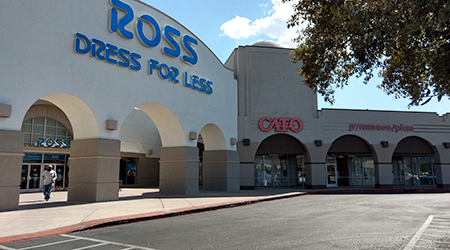
Plaza Vista Mall in Sierra Vista, AZ (Photo by Terri Jo Neff)

At issue: Does 2 specialty stores equal 1 Walmart 

SIERRA VISTA, Arizona – A rent dispute at the Plaza Vista Mall Shopping Center has prompted a lawsuit that highlights how the loss of Walmart six years ago impacted one of the mall’s smaller longtime tenants. Plaza Vista Mall, which has nearly 230,000 square feet of retail space, is located at the northeast corner of Highway 90 and Charleston Road.

The mall opened in 1988, and for years Walmart and JCPenney were the two “major anchor tenants,” which are high-traffic, high-profile stores that help attract shoppers to a mall’s smaller retailers. In 2007 discount department store Ross replaced JCPenney. Then in November 2010, Walmart left for a larger, stand-alone building across the street at the Charleston Crossing Mall.

Walmart’s departure left Ross as Plaza Vista’s only anchor tenant of a dozen remaining stores that include Payless Shoes, Dollar Tree, and Daniel’s Jewelers. Another of the stores is Cato Fashions, which had been leasing at the mall since 2003.

Cato’s lease contains an “inducement provision” which permits the women’s fashion retailer to abate (reduce) its monthly rent by 50 percent “during any period of vacancy by either one of the Major Anchor Tenants.” Cato began submitting rent checks for only $2,032.03 per month effective November 2010.

However, a lawsuit filed by 629 Sierra Vista Retail LLC of Delaware, the landlord of Plaza Vista Mall, claims Cato is in breach of contract of its lease. The landlord asserts that “any inducement or other co-tenancy requirement” has been satisfied since early 2014 when Hobby Lobby and C-A-L Ranch started sharing the 127,000 square foot space vacated by Walmart.

The landlord’s civil action filed July 19, 2016 with the Cochise County Superior Court seeks a finding that Cato must begin paying full monthly rent of $4064.06, as well as back rent, interest, attorneys’ fees, and court costs.

Sale of shopping center prompts demand for full rent

The rent disagreement flared up in early 2016, shortly after Plaza Vista was sold to an investment group headed by Friedman Integrated Real Estate Solutions of Michigan.  An attorney for the landlord commanded Cato submit full payment of rent, a demand which Cato rejected. Subsequent efforts to resolve the issue without legal action were unsuccessful.

A counterclaim filed August 24 by current lessee Cato Wo and parent company Cato Corporation based in North Carolina alleges the landlord has “failed to satisfy the requirements” of the inducement provision by not having two major anchor tenants. Cato asserts that neither Hobby Lobby (an arts and craft store) nor C-A-L Ranch (a ranch lifestyle and supply store) meet the criteria of a major anchor tenant, individually or as a set.

According to Cato’s counterclaim, the previous landlord “did not challenge Cato’s payment of reduced rent from November 2010 through January 2014.” Then, after the lease was renewed in February 2014, the landlord did not challenge Cato’s continued abated payments even though Hobby Lobby and C-A-L Ranch had opened for business in the old Walmart space.

The inducement provision also allows Cato to cancel the lease if a major anchor tenant vacates the mall and is not replaced within 12 months “by a single tenant open for business and operating exactly the same type of retail business” in all of the space. The lease states Cato’s election of one remedy “shall not preclude its exercise of any other remedy.”

The lawsuit is currently in the discovery process with depositions of key witnesses expected over the next several months. The parties have until September 25 to participate in private mediation in hopes of resolving the matter without trial.  If the case is not settled by then, judge Karl Elledge will preside over a three day trial in early 2018.

The mall owner is represented by Jonathan Saffer of Snell & Wilmer in Tucson. Sierra Vista attorney Joel Borowiec and North Carolina attorney Michael Montecalvo are representing the Cato defendants.

Contact reporter Terri Jo Neff at 520-508-3660 or [email protected]


‘Rails to Trails’ Lawsuit Settlement: $5M Fed payout to landowners along old Cochise County railroad corridor

Cochise County Railroad Corridor (source: Cochise County)

Cochise County, Arizona – The check is in the mail. That is the message several Cochise County landowners received recently after the U.S. Dept. of Justice agreed to a settlement in a decade-long lawsuit involving land encumbered by easements granted a century ago to the El Paso and Southwestern Railroad Company. The legal action involved the federal government’s interference with the landowners’ property rights along what is now known as the San Pedro rail corridor, a 76 mile long, 200 feet wide strip of land stretching from St. David, through Charleston and Bisbee, and on to Douglas.

The landowners finally prevailed in their 2007 lawsuit – known as Ladd vs. United States of America – after a mediation session was held in Tucson in June. Notice of the settlement was submitted to the U.S. Court of Federal Claims in November and now the plaintiffs are waiting on the U.S. Dept. of Treasury to issue the checks.

The payouts to individual landowners are confidential, according to Meghan Largent, an attorney with Arent Fox, the law firm based in Washington D.C. that represented the landowners. However, Largent reported the total settlement – including interest and costs – “is just shy of $5 million” with the biggest component being “delay damages” which is interest that accrued on the original money the government owed to the landowners.

The lawsuit involved legislation passed by Congress in the 1980s known as ‘Rails To Trails’ (RTT). Prior to RTT, full interest to property covered by a railroad easement reverted back to a private landowner once rail service was abandoned along that part of the corridor. But passage of RTT unilaterally eliminated the landowners’ reversionary rights in many situations, allowing the easement land to be used for public recreation trails without regard to the property owner’s longstanding rights.

Although RTT survived multiple constitutional challenges across the country, the U.S. Supreme Court ruled that under the Takings Clause of the Fifth Amendment of the U.S. Constitution, the federal government must compensate landowners in RTT cases if there is a “taking” of their property interests.

In 2012, the Court of Federal Claims affirmed that the Ladd plaintiffs were “entitled to just compensation” after RTT provisions were invoked by the San Pedro Railroad Operating Company when it discontinued rail service on part of its corridor. The court ruled the compensation must consider not only the value of the easement land but also the diminished value of the landowners’ remaining property adjoining the rail corridor.

Despite the 2012 ruling, the parties had been unable to agree on what formulas to use for calculating that compensation until the recent court-ordered mediation. Attorney Largent explained the settlement price tag is so high because “the government chose to litigate this case for eight years (including two appeals) rather than settle.” That strategy, noted Largent, “cost the taxpayers significantly more than the government’s actual liability for the land it took.”

The settlement also includes the landowners’ attorneys fees, she explained, because the “government is required to reimburse” such costs in cases involving violation of the Takings Clause.

Owen Lonsdale is one of the Ladd plaintiffs through his ownership interest of the Miller Ranch Trust property south of Saint David. Lonsdale believes that “far too often” the federal government infringes “on state and personal rights” and can do so because they have the “advantage in litigation as they have our very own tax dollars to fund attempts at illegal land takings” such as Rails To Trails.

When asked whether he would go through the process again, Lonsdale explained he felt “it’s a matter of patriotic duty” to get involved when the government “oversteps its bounds.” Permitting such actions to go unchecked, he noted, “will slowly erode our rights and set precedents, allowing such grievous actions to continue in the future.”

As part of the settlement, the Ladd plaintiffs withdrew a request to certify their case as a class action. Instead, the government agreed to not challenge a second lawsuit Arent Fox filed on behalf of 14 new plaintiffs whose property along the San Pedro rail corridor in Cochise County may have been impacted by RTT legislation. Largent said the new lawsuit – referred to as Lindstrom vs. United States of America – should be resolved quickly based on the facts already demonstrated in the Ladd case.

Contact reporter Terri Jo Neff at 520-508-3660 and [email protected]

To read the full story in Cochise County Record click here.

EDITOR’S NOTE: for more information about this matter, see this story published by the Real Estate Daily News on Sept 12, 2016