Tucson Returns to National Top 30 for Renter Demand as Phoenix Interest Grows
TUCSON, ARIZONA (June 11, 2026) — Tucson is drawing more attention from renters as the summer moving season gets underway, breaking back into the top 30 most sought-after cities by renters in the country for the first time in more than a year, reflecting a significant rise in Renter Demand.
According to the latest RentCafe.com Renter Engagement Tracker, Tucson ranked No. 22 nationally, reflecting stronger renter activity at the apartment-search stage and growing interest from nearby Phoenix.
The increased Renter Demand is largely attributed to the influx of new residents from nearby Phoenix, seeking more affordable living options.
The RentCafe.com Renter Engagement Tracker, known as REnT, is a recurring report built from millions of renter interactions on RentCafe.com. The report tracks behavior such as page views, favorited properties, saved searches, and available listings to measure which cities are gaining momentum among apartment hunters. The latest report ranked Minneapolis as the most sought-after city for renters entering summer 2026, followed by Atlanta and Miami. The West led all regions with 11 cities in the top 30.
For Tucson, the numbers indicate a market with more available inventory and more serious renter engagement.
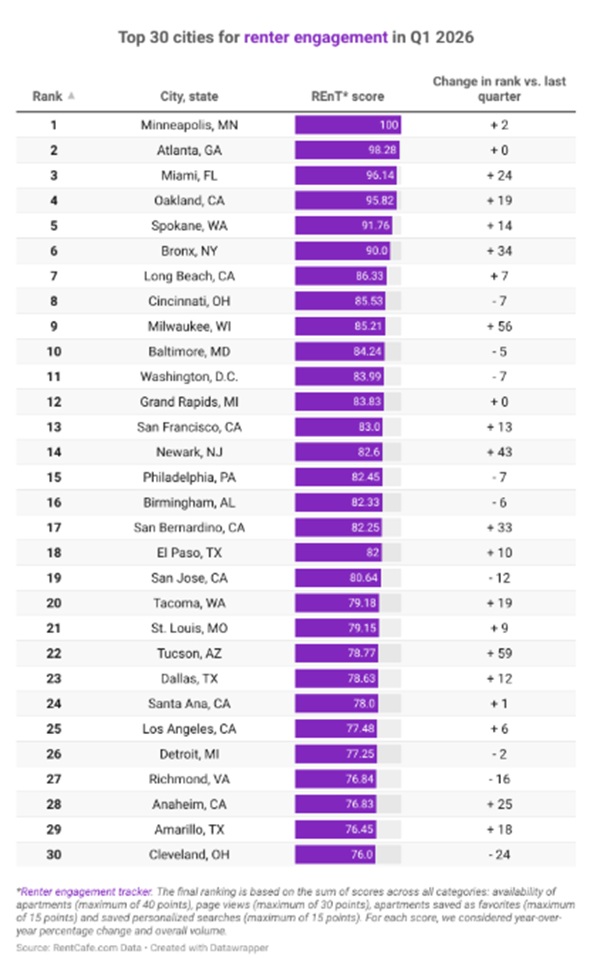
Available apartment listings in Tucson on RentCafe.com increased by 10% in the first quarter, giving renters more options as interest in the market rises. Favorited properties were up 11%, while saved searches increased 14% heading into summer. Those gains suggest renters are not just casually looking at Tucson; they are actively comparing properties, saving options, and preparing to make decisions.
At the same time, browsing activity was down 2%, which RentCafe interpreted as a sign that renters may be narrowing their choices more quickly rather than continuing to scan the market broadly.
One of the most notable findings is the source of the interest. Phoenix ranked as the second-largest source of inbound searches for Tucson apartments, nearly matching local interest. Tucson also drew renter traffic from larger western markets, including Las Vegas and San Francisco.
That Phoenix-to-Tucson interest is especially significant for Southern Arizona. As housing costs, traffic, and growth pressures continue to shape the Phoenix metro area, Tucson offers a different value proposition: a major university city, a growing employment base, access to health care, defense, logistics, and technology sectors, and a lifestyle that remains distinct from the state’s larger metro.
The data also comes as Tucson continues to see new multifamily development and investment across the region. More available listings can sometimes signal softer conditions, but in Tucson’s case, the increase is being matched by stronger renter engagement. That combination suggests the market is giving renters more choices while still attracting active demand.
For apartment owners, developers, and property managers, RentCafe’s findings indicate an increasingly regional renter pool. Tucson is not only competing for local renters; it is being considered by renters in Phoenix and other western cities who may be looking for affordability, lifestyle, education, employment opportunities, or a lower-density alternative to larger metros.
The timing is also important. Summer is traditionally one of the busiest periods for moving, and renter behavior in the spring often provides an early look at where demand may be headed. Tucson’s return to the national top 30 suggests the city is back on the radar for apartment hunters at a key point in the leasing cycle.
The broader takeaway is positive for Tucson’s rental housing market. After more than a year outside the top tier of RentCafe’s renter engagement ranking, Tucson has re-entered the national conversation. With listings up, saved searches rising, and Phoenix renters showing growing interest, the city appears to be benefiting from both new apartment options and renewed attention from renters across the region.
For Southern Arizona, that is another sign that Tucson’s growth story is not just about population numbers or construction activity. It is also about perception. More renters are looking at Tucson, saving Tucson properties, and considering the city as a place to live.