U.S. Retail Vacancy Falls to 4.8% as Holiday Spending Is Expected to Rise
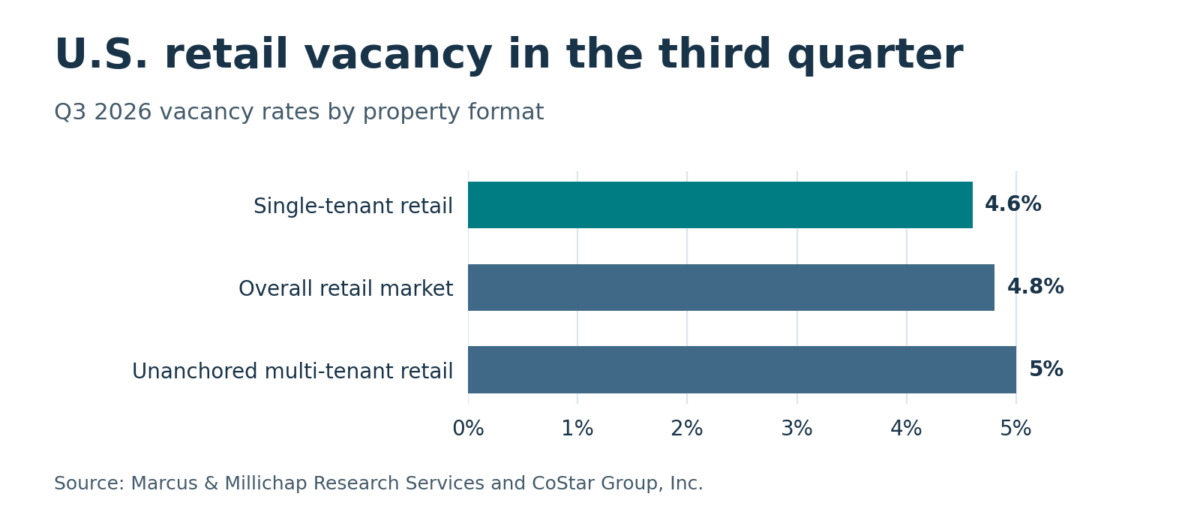
(Nov. 25, 2026) — U.S. retail landlords are heading into the holiday season with less space available to lease and more properties changing hands. National retail vacancy fell to 4.8% in the third quarter, down 10 basis points from the previous quarter, as tenants absorbed more space than developers delivered. Retail transaction activity rose 16% year over year in the 12 months ended in the third quarter, according to preliminary figures from Marcus & Millichap Research Services.
Holiday shoppers still plan to visit stores
The National Retail Federation forecasts 4.2% growth in holiday retail sales for November and December. ICSC projects growth of 4.3% to 4.9% under its holiday forecast. Those estimates follow a 5.9% year over year increase in October core retail sales, up from 5.6% in September. Core retail sales exclude motor vehicles and gasoline, and the reported figures are before inflation.
Physical stores remain central to holiday shopping plans. ICSC found that 93% of respondents expected to visit a store to make a purchase or pick up an online order, and 78% planned to spend as much as last year or more. Online sales accounted for 23.6% of October core retail spending, according to Marcus & Millichap. For shopping center tenants, that means store visits can serve both shoppers browsing the aisles and customers who have already paid online.
Household budgets are still under pressure. The New York Fed reported that debt reached $19.1 trillion in the third quarter, up $334 billion from the prior quarter. The research brief puts household debt at 58.3% of income, up from 57.3% in the previous quarter and still below its 2009 peak. It also reports that consumer savings, including money market mutual funds, rose 4% year over year in October. In ICSC’s survey, half of consumers said household or personal debt would affect their holiday spending.
Tight vacancy gives landlords room to raise rents
Third-quarter vacancy ranged from 4.6% at single-tenant properties to 5.0% at unanchored multi-tenant centers. Visits to open-air shopping centers rose 5.6% year over year as of September, while multi-tenant rents were up 2.9% over the same period, according to figures cited in the research brief.
The brief reports stronger rent gains on new leases and renewals. For owners with older leases coming due, the gap between existing and current market rents can translate into higher income. A center with vacant suites has another opportunity to grow income if it can attract tenants at current rates.
Investment activity improves as financing costs bear watching
Both single-tenant and multi-tenant retail transaction activity have risen since 2023, according to the brief. Average cap rates held near 6.6% for single-tenant properties and 7.4% for multi-tenant properties. Higher borrowing costs could put pressure on prices if buyers need more income from a property to make the financing work.
The brief expects annual retail inventory growth to stay below 0.5%, limiting competition from new space heading into 2027. That gives existing centers some support as retailers contend with tariff-related price increases and transportation costs. For investors, the outlook will depend in part on how much rent growth a property can deliver and how much it costs to finance the purchase.
Research acknowledgments
REDN adapted this article from research supplied by Marcus & Millichap Research Services and created the charts using figures from that research and ICSC’s 2026 Holiday Intentions Survey. The research brief credits the Bureau of Economic Analysis, CoStar Group, ICSC, Mastercard, the Federal Reserve Bank of New York, the National Retail Federation, Placer.ai, Real Capital Analytics, the U.S. Census Bureau and Visa. The transaction activity figure compares trailing 12-month periods and uses preliminary third-quarter data. Full report here.