UA Clears Speedway-Campbell Site for $250M Freshman Students Housing Tower
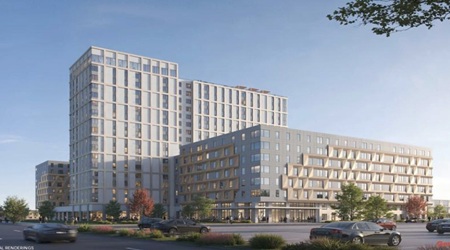
TUCSON, AZ (May 28, 2026) — The University of Arizona is moving forward with a roughly $250 million, 19-story residence hall planned for the northwest corner of East Speedway Boulevard and North Campbell Avenue, a major infill redevelopment that will add 395 units with more than 1,200 student beds, along with dining, amenities, and student-support space.
The former Palm Shadows Apartments site at 1815 E. Speedway Blvd. has now been cleared, marking a visible step forward for one of the most closely watched redevelopment corners near the university. The old apartments at Speedway and Campbell have been demolished to make way for the new student housing project, which is expected to serve first-year students.
The project is planned for the 2.49-acre former apartment site and is structured to keep construction debt off the university’s balance sheet. Under the plan outlined in the university materials, Mortenson Development would acquire the property and then sell it to the nonprofit Collegiate Housing Foundation at fair market value once CHF secures tax-exempt bond financing. CHF would then convey the land to the university and independently finance, develop, construct, and operate the residence hall under a 50-year ground lease with UA.
The bond financing is expected to be repaid over approximately 40 years through residence hall-related fees, with UA having no debt obligation.
UA said the Arizona Board of Regents approved plans for the new residence hall, with an opening targeted in time for the Fall 2028 semester. The development also supports the university’s housing policy shift: UA expects first-year students to live on campus beginning Fall 2026, with exceptions including students living within 30 miles of campus or other hardship circumstances.
University leadership framed the project as a student-success initiative.
“Living on campus is a proven predictor of student success,” UA President Suresh Garimella said in the university announcement, adding that the project helps meet on-campus housing goals and “invests in our students.”
Regent Fred DuVal also cited the importance of expanding the on-campus residential experience as the university pursues its broader student-success goals.
The new residence hall is expected to align with student demand for more suite-style units and to replace more than 600 residential beds that are being phased out elsewhere on campus.
From a real estate and development standpoint, the project continues the long-running evolution of the Speedway-Campbell corner. The former Palm Shadows Apartments property had been tied to high-rise mixed-use and student housing concepts, but those private plans did not move forward. KGUN noted that the site had been viewed by prior property owners as a prime location for tall towers with housing, dining, and retail near the university.
Nearby businesses should also benefit from the additional student population. KGUN reported that some nearby business owners are optimistic about the added foot traffic, particularly because the UA project is not expected to include ground-floor retail that could compete directly with existing businesses.
CHF, a 501(c)(3) nonprofit established in 1996, describes its mission as helping colleges and universities develop student housing using third-party nonprofit financing. CHF reports it has been involved in 70 student housing facilities totaling more than 47,000 beds across 26 states, with total project costs exceeding $4.6 billion.
The Speedway-Campbell tower is expected to be ready for move-in by Fall 2028. When completed, it will add a major new residential presence to one of Tucson’s busiest university-area intersections and further shift the corridor from older low-rise apartments toward higher-density, institutionally backed infill development.