US District Judge gives City a hiding for Inaction
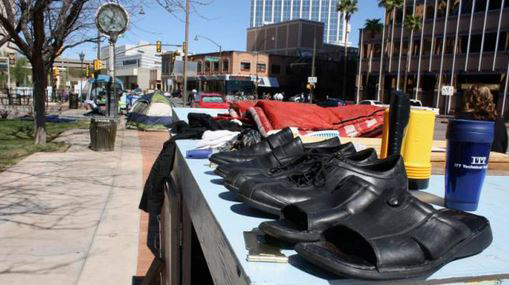
The battle between the campers at Veite de Agosto (VDA) Park in downtown Tucson and City of Tucson officials was back in the courtroom Tuesday. The federal judge who in December issued a temporary injunction against the city 3-B rule that allowed homeless people to sleep on sidewalks only if they had no more than three belongings with them.
This time, the city was seeking clarification to that temporary injunction. “The District Court’s order has converted the sidewalk into a 1,260 square-foot property storage facility, and if applied city-wide would effectively convert any sidewalk within the city of Tucson wider than five feet into a personal property storage facility,” city attorney Mike Rankin wrote in an appeal to the injunction in the 9th U.S. Circuit Court of Appeals.
However, US District Judge David C. Bury wasn’t having any part of it and stated there was no clarification needed to his injunction. “The ruling was on a freedom of speech issue in December 2014. The court can’t do anything until someone acts and the city has delayed taking necessary measures, and offered no reason why it can’t protect the city,” Judge Bury said repeatedly at the hearing.
Health and safety issues are not freedom of speech issues, pods on the sidewalk are not furtherance of free speech, both sides agreed. Judge Bury went on to say, “Photos submitted of pods on the sidewalk from the city only particularize the message that the pods show no furtherance of free speech.” There were no pods when the initial ruling was made. The injuction was made with two individual plaintiffs acting on a discrete sidewalk. Now facts have changed, there are 50-60 people and growing, living on the sidewalk in 30-40 wooden pods and public health and safety issues have surfaced to the top.
“Nothing in the first injunction prevented the city from enforcing restrictions,” Judge Bury added, “the city has the right to remove the pods.”
“The city is allowed hard closure orders, as long as they are applied equally to all citizens,” Judge Bury said and then went on to read almost verbatim from a portion of his 18-page December injunction, reprinted here for clarity:
“The problem – the City has “chosen” to treat 12 feet of sidewalk adjacent to Church Avenue from Broadway to Congress as sidewalk, subject to sidewalk ordinances, not the park-closure ordinance. The City has painted a line on the sidewalk to delineate the 12 feet it considers to be public sidewalk. The City treats areas of the sidewalk where public tables, chairs, and garbage receptacles are located as subject to the park closure ordinance. As for the 12-foot sidewalk, the City enforces the 3-B Policy: It allows Plaintiffs “and their loosely-affiliated associates” to keep a bedroll, blanket, and beverage.”
“Plaintiffs are cited, arrested, or threatened with both for obstructing the sidewalk if they sit or lie down on it with more than a bedroll, backpack, and blanket. The City confiscates any personal property exceeding the 3-B restricted list of personal property as evidence of the offence, and also confiscates personal property left unattended by its owner.”
“Plaintiffs rely on the sidewalk ordinance applicable to downtown sidewalks when they are used for First Amendment activities, provided, however, that the person sitting or lying on the public sidewalk remains at least eight (8) feet from any doorway or business entrance, leaves open a five (5) foot path and does not otherwise block or impede pedestrian traffic.”
The City admitted in December that it had not posted park closure signs and relied on the black line to inform the public. Judge Bury ruled on First Amendment rights at that time.
Judge Bury told City Attorney Mike Rankin at Tuesday’s hearing, “The city has chosen to do nothing,” and then added, “the city has delayed necessary measures to protect citizens.” There was nothing in the first ‘temporary’ not ‘permanent’ injunction that prevented the City from making reasonable time or enforcement restrictions on freedom of speech, according to Judge Bury.
Homelessness is a problem faced by most cities, but it’s the city’s problem and not one for the federal courts.
Editor’s note: The scolding took approximately 22 minutes Tuesday. But what became apparent as the Judge spoke was that Tucson has far greater problems than a few homeless people camping out in a park. What is the quality of city leadership, when no actions were taken since December? Tucson officials failed to recognize their own discriminatory practices that the injunction addresses. Instead, the City Council was willing to sacrifice health and safety of the general public. I think of all the international gem show attendees and other visitors who passed through our renovated downtown being greeted by human waste on the street. Within hours of the Judge’s comments, Tucson officials posted eviction notices on the pods at the park citing ordinance violations and giving until Friday for the campers to move out.