


ALBUQUERQUE, N.M. (December 20, 2023) – After declining for almost a decade, New Mexico’s homeless population increased 48% from the previous year. According to a New Mexico Legislative Finance Committee report, this spike is primarily due to housing shortages and rising rents.
The report said rents in New Mexico increased by 70% from 2017 to 2021 while wages increased by 15%. Zillow reports the average price for a home in New Mexico in January 2017 was $173,063; in the current market, the average New Mexico home price has increased to $293,040. For the U.S. as a whole, in the same period, the average price for a home went from $206,839 in January 2017 to $346,653 in 2023.
The Albuquerque Housing Authority, AHA, has implemented a voucher program for low-income individuals to combat housing costs. Households assisted through the Housing Choice Voucher Program pay 30% of their income toward rent. AHA pays private landlords the difference between what participating households pay and the rent for the units. The AHA says that over 4,000 Albuquerque households receive rental assistance through this program.
Watkins said that there is institutional racism built into the system that disproportionately affects certain groups of homeless individuals who should be receiving support. “We have way too many Native and Indigenous people that have been undocumented as experiencing homelessness.”
According to Watkins, this racism can be traced to the program begun in 1934 by the Federal Housing Administration to insure home mortgage loans. “Ninety percent of those loans for the first 20 to 30 years went to white families,” he said. “Insurance companies backed by the federal government deliberately would get a map and draw red lines around neighborhoods that weren’t considered worthy. And most of those people were inner city and people of color.”
These affected communities were denied credit to either buy or fix up their houses, Watkins said. The racial makeup of Albuquerque reflects this. Most of the white population lives on the eastern side of the city, where housing costs are higher, while the majority of the Hispanic population lives on the inner and southwest side of the city.
Discrimination was prohibited by Title VII of the Civil Rights Act of 1968 “concerning the sale, rental, and financing of housing based on race, religion, national origin, sex, (and as amended) handicap and family status,” according to the Department of Housing and Urban Development.
Despite the Civil Rights Act, the legacy of decades of discrimination is still seen, including in this study from the Massachusetts Budget & Policy Center that showed in 2019 “only 44.6% of Black households, 48.1% of Latinx, and 57.1% Indigenous, Asian, or Pacific Islander households owned their homes compared to 73.7% of White households.”
“I think the system is not designed in a way that people really know exactly where to go to get the help that they need,” said Monet Silva, executive director of the New Mexico Coalition to End Homelessness. According to Silva, many of the coalition’s programs provide support to individuals and families where they most need help, such as with mental illness.
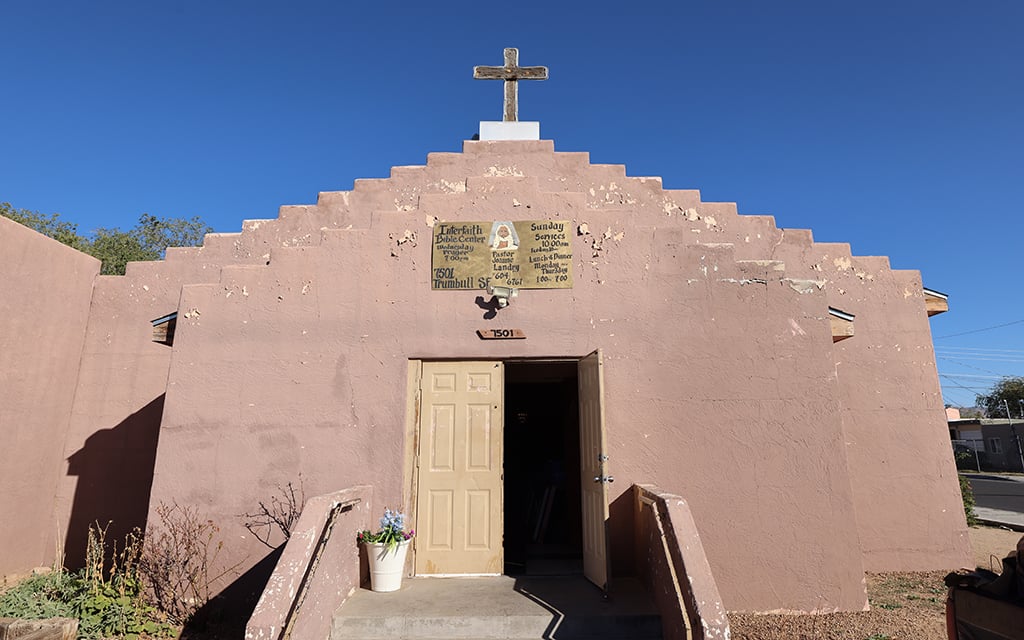
The Compassion Services Center in the International District of Albuquerque on Oct. 30. (Photo by Caleb Scott/Cronkite News)
“We need that intensive support for families on their own terms in their own home, focusing on their strengths to help them problem-solve because families are the best solutions to their problems,” Watkins said.
The coalition administers housing programs both in Albuquerque and throughout the state for people who are homeless. It maintains a local, centralized database of information on clients and their needs that enables the organization to coordinate services with partner providers throughout the state. People are evaluated to determine individual vulnerabilities, disabilities and factors such as whether someone is a survivor of domestic violence.
Alexandra Paisano is the coordinator for the coalition’s Coordinated Entry System, a process whereby people experiencing homelessness can access quick and streamlined services. She said that Albuquerque consistently gets about 200 new household applicants per month, and the number of people per household can vary from two to nine. The coalition recently received funding from Albuquerque to put people in a transitional phase into hotels.
Nearly half of all renters in Albuquerque spend more than 30% of their income on housing, according to city data. To classify as low income, an individual must have an income at or below 80% of the area median income, AMI. Very low income is classified at 50% of the AMI and extremely low income is at 30% of AMI. The AMI is classified each year by HUD.
The coalition keeps an accurate count of the homeless population, tracks the patterns of services used in the state and tracks patterns of homeless causes and needs.
“It’s a way of rebuilding the system to have a binding list of everyone that is experiencing homelessness so we know exactly who they are and what their needs are so we can address those head-on and be able to get them into housing or the support that they need,” Silva said.