


Source: Elliott D. Pollack & Company, The Monday Morning Quarterback, October 5, 2026.
ARIZONA (Oct. 6, 2026) — Arizona’s economy gained momentum in the second quarter, but slowing national hiring, persistent inflation and higher mortgage rates are creating a more difficult environment for consumers, businesses and real estate investors, according to Elliott D. Pollack & Company’s October 5 Monday Morning Quarterback report.
Arizona’s real gross domestic product grew at a 2.5% annual rate in the second quarter, up from 0.8% in the first quarter and exceeding the nation’s 2.2% growth rate. The improvement signals stronger economic activity after a sluggish start to the year, although borrowing costs and household expenses continue to constrain the outlook.
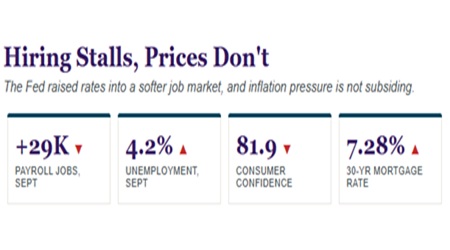
Nationally, employers added just 29,000 jobs in September, falling short of expectations for approximately 90,000. Unemployment increased to 4.2% from 4.1% in August, while downward revisions removed a combined 60,000 jobs from the July and August totals. July now shows a loss of 10,000 jobs.
Health care, construction and manufacturing accounted for much of September’s hiring, adding 17,000, 11,000 and 9,000 jobs, respectively. Financial activities lost 7,000 jobs. Average hourly earnings increased only 0.1% during the month and 3.0% over the year.
Despite weaker hiring, the report describes a labor market that is slowing rather than collapsing. Initial unemployment claims fell to 197,000 for the week ending September 26, and layoffs remained at 1.6 million in August. Job openings declined to 7.1 million from 7.3 million in July, suggesting employers are becoming more cautious about expanding their workforces.
Inflation presents the other side of the Federal Reserve’s challenge. The Personal Consumption Expenditures price index, the Fed’s preferred inflation measure, increased 3.4% over the year in August, compared with 2.7% a year earlier. Core PCE inflation, which excludes food and energy, was 3.0%.
Manufacturers also reported mounting cost pressure. The Institute for Supply Management’s manufacturing prices index climbed to 77.9 in September from 71.1 in August. A reading above 50 indicates that more purchasing managers reported rising prices than falling prices.
According to Pollack’s report, the Fed raised its benchmark interest rate in September to a target range of 3.75% to 4.00%, responding to renewed inflation pressure. The weak jobs report now complicates the case for additional increases.
Pollack’s assessment is that policymakers will likely need more evidence of sustained labor market weakness before changing direction. Another disappointing employment report, however, would make further tightening harder to justify.
For Arizona real estate, higher mortgage rates remain a significant obstacle. The average 30-year fixed mortgage rate reached 7.28% last week, up from 7.03% a week earlier and 6.71% at the beginning of September, according to figures cited in the report.
Greater Phoenix home prices were nearly unchanged in July, increasing just 0.05% from a year earlier, according to the S&P Cotality Case-Shiller index. That compares with a 2.5% increase for the index’s 20-city composite.
National home prices rose 1.9% year over year in July, although prices adjusted for inflation have declined for 14 consecutive months. The combination of modest price growth and higher financing costs continues to challenge affordability.
Construction activity showed some monthly improvement. U.S. construction spending increased 0.9% in August to a seasonally adjusted annual rate of $2.20 trillion, but remained 1.7% below its year-earlier level. Residential construction spending rose 1.1% during the month.
Consumers are feeling the pressure. The Conference Board’s consumer confidence index fell to 81.9 in September from 88.6 in August, its lowest level since 2014. Its expectations index declined for a third consecutive month to 63.6.
Household spending nevertheless continued to rise. Personal income increased 0.2% in August, while spending advanced 0.9%, or 0.6% after inflation. With spending growing faster than income, the personal saving rate stood at 4.1%.
Arizona households also face elevated fuel costs. The statewide average price for regular gasoline was $4.77 per gallon on October 1, approximately $1.22 above a year earlier and higher than the national average of $4.41, according to AAA figures cited by Pollack.
Regional employment indicators offered some encouragement. ADP reported that private employers in the Mountain region, which includes Arizona, added 18,000 jobs in September. Arizona’s initial unemployment claims declined by 147 to 2,196 for the week ending September 26.
Pollack does not see the latest figures as pointing to an immediate recession. Revised GDP growth, continued manufacturing expansion and relatively low layoffs suggest the economy is still moving forward. For Arizona’s real estate market, however, stronger state economic growth is arriving alongside financing and affordability pressures that could temper demand.