


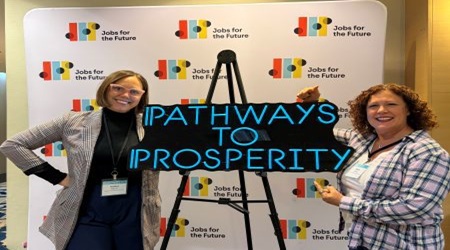
The national gathering provided an opportunity to explore innovative approaches to workforce development and identify strategies to better connect Southern Arizona students with meaningful, high-quality career opportunities.
Jobs for the Future's Pathways to Prosperity initiative is a national effort launched in 2012 in collaboration with the Harvard Graduate School of Education. The initiative brings together education, workforce, business, and government leaders to strengthen pathways from high school through postsecondary education and into rewarding careers. Its goal is to ensure young people have access to career exploration, industry-recognized credentials, work-based learning, and the skills needed to succeed in today's economy.
Held twice annually, the Pathways to Prosperity Institutes bring together state and regional teams from across the country to share successful programs, explore research-based strategies, and develop solutions to common workforce challenges. The initiative emphasizes collaboration between education and industry to create stronger regional talent pipelines and expand economic opportunity.
Pima County's participation builds on its ongoing partnership with CFA and JFF. Supported by a Caterpillar Foundation grant, this collaboration is strengthening pathways from high school to industry while expanding Pima County's Middle School Career Exploration pilot, which introduces students to career possibilities at an earlier age.
Several innovative approaches highlighted during the Institute offered valuable lessons for Southern Arizona.
Colorado's "Big Three" initiative emphasizes preparing students for life after graduation through college credits, industry-recognized credentials, or work-based learning experiences. The American Job Quality Study reinforced the importance of connecting workers not just to employment, but to quality jobs that offer opportunities for economic advancement.
One particularly relevant example came from WSU Tech in Wichita, Kan., where early STEM exploration, dual credit opportunities, rural outreach, and industry mentoring with Boeing are helping students transition into aviation careers. The model offers promising ideas for Pima County's efforts to strengthen workforce pipelines in aviation maintenance, aerospace and defense, advanced manufacturing, and other priority industries.
The Institute also provided an opportunity for regional collaboration among representatives from Pima County Economic Development, Cochise College, JobPath, Pima Community College, Sunnyside School District, CFA, and JFF. A key takeaway was that Arizona already has many strong workforce programs in place, and the greatest opportunity lies in better connecting and aligning those resources.
For Pima County, these efforts directly support regional economic development priorities. Employers consistently identify workforce availability as a critical factor in their ability to grow and expand. Developing local talent pipelines helps businesses meet their workforce needs while creating opportunities for young people to build successful careers without leaving Southern Arizona.
The lessons from Seattle reinforce a shared commitment to an education and workforce system that is industry-informed, data-driven, and student-centered. By connecting students with career opportunities earlier, strengthening partnerships with employers, and expanding access to quality jobs, Pima County and its regional partners are working to build a stronger economy and greater prosperity for all.