


 TUCSON, AZ — Tourism appears to be on the rise in Pima County, according to a new study issued by the Making Action Possible for Southern Arizona, and referred to as the MAP Dashboard (MAP), is a partnership with the University of Arizona Eller College, the Community Foundation for Southern Arizona (CFSA), and the Southern Arizona Leadership Council (SALC).
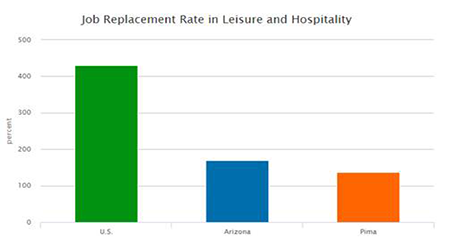
The report states the leisure and hospitality sector has bounced back from the job losses during the Great Recession. In fact, the industry has not only replaced all of the jobs lost during the downturn, it has added another 37.5 percent. Of the industries in the county that lost jobs during the economic downturn, leisure and hospitality was one of only two to attain full job replacement by 2014, the report said, adding the other business sector was natural resources and mining.
Employment in leisure and hospitality includes jobs in arts, entertainment, and recreation, as well as accommodation and food services.
The MAP Dashboard report suggests the overall increase in leisure and hospitality employment was driven primarily by gains in accommodation and food services, possibly indicating improvement in local tourism activity.
Calling the leisure and hospitality industry “an important part of Pima County’s economy,” the MAP Dashboard report said jobs in those industries represent 11.4 percent of all nonfarm jobs in 2014. In addition, 4.3 percent of Pima County’s Gross Domestic Product (GDP) was in leisure and hospitality, slightly higher than the national share of 3.8 percent.
Pima County employment in arts, entertainment and recreation is up 2.3 percent since the end of the Great Recession, the report notes, while employment in accommodation and food services rose 9.5 percent. Food services jobs are up 9.2 percent, while accommodation jobs rose at a rate of 10.8 percent.
The MAP Dashboard report shows employment in the arts, entertainment and recreation sector represented 12.8 percent of the jobs in leisure and hospitality in 2013, while jobs in the accommodation and food services sector made up the remaining 87.2 percent. Food services represented 69.5 percent of jobs and accommodation 17.7 percent.
“The leisure and hospitality industry serves both local residents and visitors to the region, making it an important indicator of tourism activity,” the report said. In addition, it noted, “Employment gains in accommodations are a positive sign for the local tourism industry since this sector primarily serves residents from outside the county.”
A detailed breakdown of figures in the report show employment in amusement, gambling and recreation accounted for 78.7 percent of all the jobs in arts, entertainment and recreation. Museums, historical sites and similar institutions represent 5.9 percent of the jobs.
Jobs in traveler accommodations made up the majority of the accommodation sector at 95.4 percent, while restaurants and other eating places accounted for most of the jobs in the food services sector with a 90.8 percent share.
The MAP Dashboard Project was created to measurably improve Southern Arizona through data-driven collective civic action and education. University of Arizona’s Eller Economic and Business Research Center has built the MAP Dashboard and will keep the information up to date. The MAP Dashboard Project provides our region’s first common set of indicators in a single, easy-to-access source of reliable information. That information is available at www.mapazdashboard.arizona.edu or www.mapazdashboard.com