


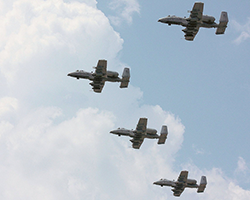
This week, U.S. Representative, Martha McSally (R-CD 2) sent two letters to the HEREHouse Armed Services Committee Chairman emphasizing the importance of two aircraft currently housed at DM: the A-10 Warthog and EC-130H. Both of these aircraft are currently deployed in the Middle East in the fight against ISIS and bring irreplaceable capabilities to our battlefield.
She also penned the following op-ed in the New York Times titled, "Saving a Plane that Saves Lives," to make the case for keeping the A-10 flying.
Op-ed by U.S. Rep. Martha McSally as published in the New York Times:
WASHINGTON — When American troops find themselves fighting for their lives, there is no better sound than an A-10, a plane officially nicknamed the Thunderbolt II but known affectionately by the troops as the Warthog, firing its enormous 30-millimeter gun at the enemy. It might not be pretty, but the A-10 is our most capable close air-support aircraft, and its arrival on the battlefield signals survival for our troops and annihilation for our enemies.
Yet over the last two years, the Obama administration and the Air Force leadership have been working overtime to mothball our entire A-10 fleet, 13 years ahead of schedule. They claim that other, newer planes can do the same job, that it’s too slow and vulnerable and that it’s too expensive.
I appreciate the budget pressures that the Pentagon faces these days. But those arguments have serious flaws — and if we retire the A-10 before a replacement is developed, American troops will die.
Before running for office, I was an A-10 squadron commander with 325 combat hours. During my time in uniform and since coming to the House and taking up the fight to keep the plane, I have heard countless stories from American soldiers about how the A-10 saved their lives.
In 2008, Marine Master Sgt. Richard Wells and his team were on patrol in Afghanistan when they were ambushed. “It was the first time in my life that I thought to myself, ‘This is it, we’re going to die, we’re not going to make it out of this,’ ” he recalled in a recent interview.
The Marines were severely outnumbered, cornered, and in close combat with dozens of insurgents. Because of the poor weather, fast-moving fighters above the clouds were unable to identify the targets or get close enough to engage. Soon two Marines were seriously wounded, and the enemy was 50 feet away.
Suddenly two A-10s descended below a heavy layer of clouds. The planes are extremely maneuverable and designed to fly close to the ground. Coming within 400 feet of the mountains, they made nearly a dozen gun passes each, giving Sergeant Wells’s team cover to run to safety. Without the A-10 and the exceptional training and bravery of its pilots, six Marines would have died that day.
True, other planes and drones can do close air support. But every close-air-support scenario is different, and every platform brings strengths and weaknesses to the fight. The A-10 has unique strengths for the most complex and dangerous such missions.
To read the full op-ed, click HERE.