


TUCSON, AZ (April 30, 2026) — The Regional Transportation Authority’s first quarterly analysis following voter approval of RTA Next focuses largely on closing out the original 2006 RTA Plan while beginning the transition to the new 20-year regional transportation program. This analysis is crucial as the RTA Moves Forward in its efforts to enhance transportation infrastructure.
The March 26 quarterly report was presented to the RTA Board just over two weeks after Pima County voters approved Propositions 418 and 419 on March 10. Those measures authorized the RTA Next transportation plan and the continuation of the half-cent excise tax to fund it. While the report is primarily a 2006 RTA Plan closeout update, it also identifies seven remaining roadway and bike improvement projects that will move into RTA Next for additional funding and delivery as the region moves forward.
The post-election transition also includes a new citizen oversight structure. On April 2, the RTA announced it was seeking applicants for a new Citizens Accountability for Regional Transportation Committee, or CART Committee, to oversee project and program delivery of the voter-approved $2.67 billion RTA Next plan and the fiscal management of the countywide half-cent sales tax, which took effect April 1. The new CART Committee will include 15 members: eight appointed by RTA member jurisdictions and seven at-large members appointed by the RTA Board, including four City of Tucson residents. Current CART Committee members will serve through June 2026, with the new committee taking effect July 1 as RTA Moves Forward.
The quarterly analysis outlines the status of the original 20-year plan, including financial performance, project delivery, transit services and remaining construction activity. RTA staff identified quarterly analysis, annual public reporting, and financial and performance audits as ongoing accountability measures for the program.
According to the report, the original 2006 RTA forecast projected $2.7 billion in revenue over the life of the plan. Actual revenue collections are now projected to reach approximately $1.7 billion over the 20-year period. Despite that gap, RTA staff reported a projected $418 million fund balance using expenditure data through the second quarter of fiscal year 2026.
The five-year drawdown schedule shows roadway programming of approximately $121.4 million in FY 2027, $131.8 million in FY 2028, $97.9 million in FY 2029, $38.4 million in FY 2030, and $22 million in FY 2031, ending with an estimated fund balance of about $6.6 million.
The closeout overview identifies 17 roadway corridor phases or segments actively underway, seven roadway or remaining bike improvement projects now funded under RTA Next, 10 remaining greenway, pathway, bikeway, or sidewalk projects needed to close out that sub-element, and one remaining wildlife project underway to close out the environmental sub-element. Safety projects are listed as completed, while transit services continue through the end of the plan.
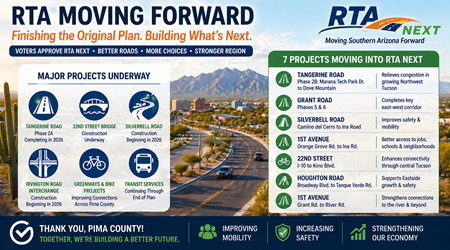
Several major roadway projects are under construction and scheduled for completion in 2026, including Tangerine Road Phase 2A from I-10 to Marana Tech Park Drive, the final segment of Sunset Road, the final segment of Downtown Links, Grant Road Phases 3 and 4, and Valencia Road from Kolb Road to Houghton Road.
Other projects are scheduled to begin construction in 2026. Those include the 22nd Street bridge, expected to take approximately three years; Silverbell Road from Goret Road to Camino del Cerro, expected to take two to three years; Grant Road at the Union Pacific Railroad crossing, expected to take about six months; the Irvington Road interchange in partnership with ADOT, expected to take approximately two years; Valencia Road from I-19 to Alvernon Way, expected to take about one year; and Houghton Road from Irvington Road to 22nd Street, expected to take two to three years.
Additional projects are in procurement, design or right-of-way activity, including 22nd Street from Camino Seco to Houghton Road, the Harrison Road bridge over the Pantano Wash, and the Barraza-Aviation connection.
Projects now included in RTA Next include Tangerine Road Phase 2B from Marana Tech Park Drive to Dove Mountain, Grant Road Phases 5 and 6, Silverbell Road from Camino del Cerro to Ina Road, 1st Avenue from Orange Grove Road to Ina Road, 22nd Street from I-10 to Kino Boulevard, Houghton Road from Broadway Boulevard to Tanque Verde Road, and 1st Avenue from Grant Road to River Road. The report notes that preliminary design activities are underway for 1st Avenue from Grant to River.
The quarterly review also highlights several focused project concerns. On Tangerine Road Phase 2A, widening activities are complete, but remaining work at the railroad tracks and crossing modifications depend on a committed schedule from Union Pacific Railroad.
On the 22nd Street bridge replacement from Kino Parkway to Tucson Boulevard, construction is underway, but additional funding is needed due to a high bid and final preconstruction costs. Staff recommended that the Board approve an intergovernmental agreement amendment to provide additional funding to restore contingency and cover recently performed preconstruction activities.
For Silverbell, Valencia, and Houghton Road projects, design, permitting, right-of-way, and utility relocation are fully underway, while the report cites an uncertain bidding climate and updated cost estimates. Valencia Road from I-19 to Alvernon Way is expected to start construction later in 2026, while 22nd Street from Camino Seco to Houghton Road and the Harrison Road bridge over the Pantano Wash are expected to begin sometime in 2027.
Bike and pedestrian projects remain active but face cost pressure. RTA staff reported that several bike and pedestrian projects are over budget, and that they are pursuing other funding opportunities and evaluating potential phasing options.
Environmental and Economic Vitality projects underway or in construction, and scheduled for completion in 2026, include 2nd Street University of Arizona bike improvements, the Naranja multi-use path, and the La Villita and El Toro multi-use paths. Remaining projects include bike boulevard, sidewalk, and multi-use path projects scheduled for summer or fall 2026, along with the State Route 86 wildlife crossing project for FY 2028.
Transit remains one of the largest elements of the original RTA program. The report shows a 20-year transit services budget of $533.8 million, with $527 million in expenditures to date. RTA-funded and supported services include Sun Tran, Sun Van, Sun Express, Sun Link, Sun Shuttle general services, dial-a-ride, and paratransit.
Transit service highlights include approximately 41.6 million total trips, including 20 million RTA-funded Sun Tran expanded evening and weekend trips, 12 million Sun Link trips, 4 million Sun Shuttle bus trips, 2 million RTA-funded Sun Van trips, 2 million Sun Shuttle ADA trips, and 1 million RTA-funded Sun Express trips.
The report also previews RTA Next tracking, noting that future quarterly reporting is expected to review first steps, active project status, funding needs and sources, pavement allocations, and delivery performance analytics across roadway, pavement, transit, safety, ADA, and active transportation, and environmental elements.
The quarterly analysis underscores the scale of the transition now underway: closing out a 2006 program that collected significantly less revenue than originally forecast, advancing major corridor projects still in motion, continuing transit services through the end of the current plan, and beginning a new delivery and accountability framework under RTA Next.