


TUCSON, AZ (May 8, 2026)— Tucson’s coworking market remains far smaller than Phoenix’s, but new Q1 2026 data from CoworkingCafe shows the Old Pueblo remains competitive on price across most major flexible-office categories.
Tucson had 22 coworking spaces at the end of the first quarter, compared to 177 in Phoenix. Tucson’s leading operators include Regus with five locations, Spoke Coworking with two, Intelligent Office with two, and The L Offices with two. Spaces, HQ, and several independent operators each have a single Tucson location.
National-brand operators accounted for seven of Tucson’s 22 coworking spaces, or approximately 31% of the market, indicating that while the Tucson coworking sector is modest in scale, it still has a meaningful national-brand presence.
Tucson’s pricing advantage is where the market stands out. Median monthly coworking memberships were $200 in Tucson, $220 in Phoenix, and $220 nationally. Tucson day passes were $32, compared to $39 in Phoenix and $33 nationally. Meeting rooms averaged $40 per hour in Tucson, below Phoenix’s $50 per hour and the national median of $45.
The exception was virtual offices. Tucson’s median virtual office rate was $209 per month, higher than Phoenix’s $189 and well above the national median of $169. That is notable given Tucson’s smaller market size and fewer coworking locations.
Overall, Tucson was more affordable than Phoenix on three of the four price points tracked. Monthly memberships were $20 less, day passes were $7 less, and meeting rooms were $10 per hour less. Virtual offices were the only category where Tucson was priced higher than Phoenix.
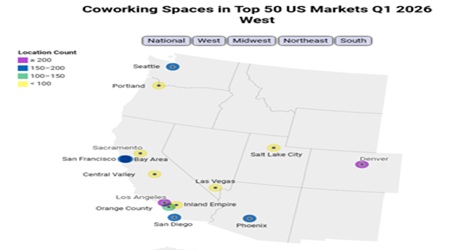
Phoenix, by comparison, remains Arizona’s dominant coworking market. According to CoworkingCafe’s Q1 2026 U.S. Coworking Industry Report, Phoenix had 3.37 million square feet of coworking space, up 2% quarter-over-quarter, ranking 14th nationally by footprint. Phoenix also had 177 coworking locations, up 3% quarter-over-quarter, making it the largest coworking market in Arizona and the third-largest in the West by number of spaces, behind Los Angeles and Denver.
Phoenix’s average coworking space size was 19,059 square feet, slightly above the national average of 17,945 square feet. Coworking accounted for 2.3% of Phoenix’s total office inventory.
The top operators in Phoenix were Regus with 36 locations, Industrious with 9, Spaces with 7, Bellagio Executive Plaza with 7, and America’s Health Suites with 6. Together, those five operators accounted for nearly 37% of Phoenix’s coworking locations.
Nationally, CoworkingCafe reported that the U.S. coworking market reached 9,136 active locations by the end of Q1 2026, up 3.2% from the previous quarter. Total coworking footprint grew to 163.9 million square feet, up 2.9%, adding nearly 4.5 million square feet of flexible workspace in three months.
The report also noted that coworking still represents only 2.28% of total U.S. office inventory, suggesting additional room for growth as flexible workspace continues to evolve beyond the largest gateway markets.
CoworkingCafe said its Q1 2026 report was based on proprietary CoworkingCafe listing data available as of March 2026, tracking coworking spaces, square footage, leading operators, and median starting prices for memberships, day passes, meeting rooms, and virtual offices.
Editor’s Note: Tucson’s coworking market may be small compared to Phoenix, but that may create opportunity for new and growing businesses. The market offers a more affordable entry point, a mix of national and independent operators, and flexible workspace options that allow entrepreneurs, startups, and small companies to establish a professional presence without committing to traditional office space. As Tucson continues to build its entrepreneurial, technology, bioscience, and professional services sectors, coworking can serve as a practical first step for companies testing the market, expanding their teams, or launching new ventures in Southern Arizona.
Read the full report here: U.S. Coworking Industry Report Q1 2026