


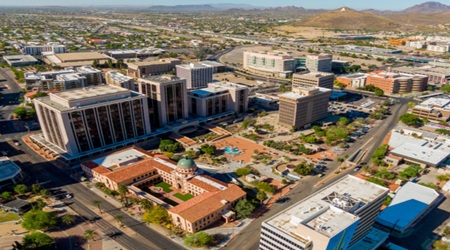
PIMA COUNTY, ARIZONA (Nov. 3, 2026) — Preparing sites for investment, tackling barriers to development and keeping talented graduates in Southern Arizona are among the priorities in Pima County’s proposed Economic Development Strategic Plan for 2026–2029.
The proposed strategy outlines 31 recommendations aimed at strengthening the regional economy, including 15 new initiatives. For the commercial real estate and business communities, it offers an encouraging agenda: improve development readiness, strengthen business recruitment and support the companies already operating here.
Forwarded by County Administrator Jan Lesher for consideration at the October 27 Board of Supervisors meeting, the plan builds on the County’s 2023–2026 strategy while expanding its attention to innovation, international investment and economic competitiveness.
Four priorities guide the work: business retention and expansion, business attraction, infrastructure development and workforce development.
A significant component involves preparing County land for economic development. The plan calls for identifying infrastructure and utility needs on designated County properties, evaluating additional land for the economic development portfolio and advancing shovel ready site certification for priority parcels. Updated property profiles and proactive marketing would help connect those sites with prospective employers.
The strategy also proposes reviewing County development standards, zoning frameworks and alternative compliance pathways to identify opportunities for greater efficiency. A separate business climate initiative would systematically identify administrative, regulatory and procedural barriers, gather business feedback and establish public accountability for measurable progress.
Together, those recommendations address practical factors that influence investment decisions: whether a suitable site is available, whether infrastructure can support it and how efficiently a project can move forward.
Innovation receives greater emphasis through a proposed downtown Tucson Innovation Hub. The concept would support advanced manufacturing, provide makerspace and business expansion resources, and connect startups and small businesses with programming, investment and other assistance.
The plan also elevates the commercialization of University of Arizona research and the transition from startup to growing company as explicit priorities.
Seven industries anchor the strategy: aerospace and defense; health and health innovation; advanced manufacturing; clean and renewable energy; transportation, distribution and logistics; advanced and emerging technologies; and tourism.
Tourism joins the priority list in this update, recognizing the economic value of the region’s cultural heritage, visitor attractions and UNESCO City of Gastronomy designation. Additional recommendations focus on optics and photonics, along with mining related engineering, automation and environmental technologies.
International recruitment would expand as well. The County proposes building on relationships with Mexico and Canada while targeting Taiwan, Japan and South Korea. Taiwan receives particular attention for opportunities involving semiconductor suppliers and related technologies.
On workforce development, the plan calls for a graduate retention and talent attraction strategy involving the University of Arizona, Pima Community College and priority industry employers. Expanded career exploration, training and employer partnerships would help residents access better paying jobs while strengthening the talent pipeline.
Housing affordability, childcare and quality of life are also treated as factors in economic competitiveness, reflecting their influence on workforce participation and recruitment.
The proposed plan pairs its agenda with an annual Economic Development Impact Report and expanded market intelligence. Most numerical performance targets would be established after the first full year of implementation, using that year’s results as a baseline.
For Southern Arizona’s business community, the proposal provides a framework for turning regional strengths into additional investment. Its progress will be measured in prepared sites, growing businesses, career opportunities and improvements in the development process.
Source: Pima County Proposed Economic Development Strategic Plan, 2026–2029.