


By: Ajay Madhvani, MAI, AM Valuation Services, PLLC, in Tucson
(September 12, 2025) -- The purpose of the Tale of Three Cities is to highlight the strengths and weaknesses of Tucson, Arizona, compared to its sister cities—Albuquerque, New Mexico, and El Paso, Texas. This trio is a sisterhood, as they have many commonalities, including climate and population size. They also all share the distinction of a military base and a university. The statistics and data shown herein illustrate the big picture and may not reflect exact figures. Since our last publication in June of 2024, there have been some changes. There is currently less emphasis on renewable energy and more emphasis on AI and technology. The three cities are also experiencing significant market shifts, similar to the rest of the nation, due to tariffs, immigration policies, and major changes in federal priorities.
Tucson, Arizona
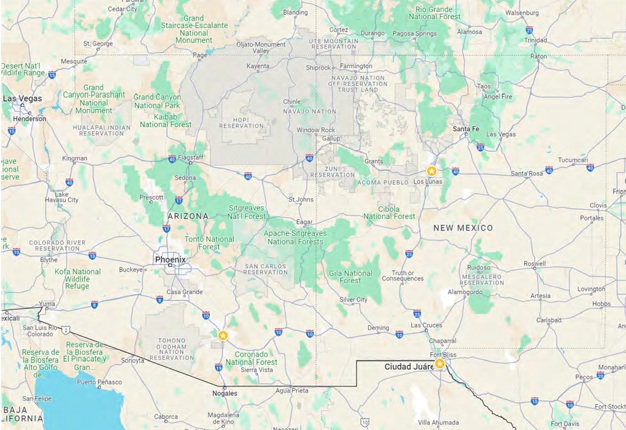
Tucson is about 60 miles north of the US-Mexico border and about 100 miles south of Phoenix, Arizona. The metropolitan population is about 1.08 million. Major industries in Tucson include defense/aerospace, healthcare, and mining. The University of Arizona is a major economic driver in the Tucson area. A large entertainment venue is currently under construction, known as the Mosaic Quarter, along the southeast side of I-10 and Kino Parkway. The project will include a 3,000-seat ice rink, a large field house, a sportsplex, and a pavilion.
The current real estate trends have shifted since last year, with a decreased emphasis on solar energy and a growing focus on the AI and tech industry. Tucson has also become a distribution hub for Southern Arizona with the Port of Tucson. The Port of Tucson is a full-service inland port, rail yard, and intermodal facility. The port spans 767 acres and features 50,000 linear feet of rail track, along with cold storage, dry storage, distribution, and manufacturing facilities. There are four Amazon facilities in the Tucson area: the 857K SF Fulfillment Center built in 2019, the 49,500 SF “Last Mile” facility, 270K SF Delivery Station, and the newest is a 220K SF facility in Marana. The Marana facility has been completed and is currently operating at about half capacity. Tucson International Airport continues to expand with new upgrades, safety enhancements, expansions, and maintenance projects. In 2026, Tucson Electric Power is anticipated to complete the Roadrunner Reserve project, which is a 200-megawatt and 800-megawatt-hour battery energy storage system located in southeast Tucson. This project will have the capacity of powering 42,000 homes for four hours.
The most controversial potential development is “Project Blue”, an Amazon-linked AI data center facility. The facility would be rolled out in two phases, and would create about 3,000 temporary construction jobs, and about 180 permanent positions. The jobs would come at a significant cost of Tucson’s potable water supply, and excessive electricity use. The TEP power plant would have to be expanded with a fossil fuel power plant, and reclaimed water would have to be further cleansed to potable quality. The data centers are also loud, and the additional power usage would result in more air pollution. The City of Tucson council rejected the development with a 7-0 vote, but the project backers are still trying to get the project through Pima County, and Arizona Corporation Commission. As of September 2025, the project is looking less likely, but is still a possibility.
In April of 2025, Sion Power Corporation, a Tucson-based battery developer for electric vehicles installed a new large-format battery cell production line at its manufacturing facility. Becton Dickinson completed a 120,000 SF final stage manufacturing and sterilization facility on 32 acres, on the northeast side of Kolb Road and Valencia Road in 2025. The company says that the facility will employ about 40 skilled people. Hudbay Minerals is beginning Copper World Complex on the west side of the Santa Rita Mountains, about 28 miles southeast of Tucson. Copper World Complex is anticipated to be a 44-year mining project and will create 400 direct jobs. As of early 2023, Hudbay was carving roads, drill pads and clearing ground for tailings piles. On January 2, 2025, it was announced that Hudbay Minerals received an air quality permit for Copper World Complex.
On September 10, 2024, Lincoln Property Company broke ground on Phase I of I-10 International. This project is an industrial project that will total more than 1 million square feet on 79 acres at the southeast corner of Alvernon Way and Los Reales Road.
Nefab announced the opening of a new 140,000 SF facility on November 14, 2024. The facility is equipped to deliver eco-friendly wood and fiber-based packaging for various sectors, including semiconductors, automotive, aviation, mining and construction, and is anticipated to create 100 jobs.
On January 27, 2025, Schnitzer Properties announced that it is investing $73 million in two projects on the city’s south side. The Drexel Commerce Center will be two building consisting of a total of 184,080 square feet. The Corona Commerce Center will be a 146,080 square foot building. Leases will be offered for spaces that range from 6,700 SF to 184,080 SF.
An ongoing issue with Tucson, as well as the other two cities, is water availability. Tucson is heavily dependent on the Central Arizona Project (CAP) canal for water, which may be less available in the long term with ongoing cuts from long-term droughts and overusage. However, the water table is currently up from prior years, with excess Colorado River water in aquifers. Other options will need to be explored soon for Tucson to achieve sustained growth.
The major difference between Tucson and its sister cities is that it is in the shadow of a much larger city. The Phoenix metropolitan area is about 5 million people and has sports venues, a much larger international airport, corporate industries, loop freeways, and a light rail line. This is both a benefit and a detriment to Tucson. It could be seen as a detriment, since the state and corporations focus their time and energy on the greater Phoenix area.
Albuquerque, New Mexico
Albuquerque is about 300 miles north of El Paso, 400 miles northeast of Phoenix, Arizona, 400 miles south of Denver, 450 miles northeast of Tucson, and 600 miles east of Las Vegas. The metropolitan population is about 926K. Major industries in Albuquerque include Defense/Aerospace, Bioscience, Renewable Energy, Digital Media and Film, and Manufacturing.
Albuquerque is the hub of New Mexico and has a rich culture. The city has a strong central downtown core, four seasons, and minor league professional sports. Albuquerque is served by two interstates, also like Tucson. The city has similar water issues to Tucson, but the water table is up from past years due to active water conservation and reclamation efforts.
Albuquerque has a commuter rail line, known as Rail Runner, traveling north-south from Belen, through the city, and to Santa Fe, about 60 miles to the north, and the Albuquerque Rapid Transit (ART). The Rail Runner and ART connect metro Albuquerque visitors and residents to various destinations throughout the area. New developments continue on the west side of the city. The city generally grows to the west, given the surrounding public lands and geography of the land to the north and east. Downtown 2050 is an initiative in Albuquerque to continue the revitalization of downtown, and is a continuation of Downtown 2025. In December of 2022, the City of Albuquerque announced a $95 million Industrial Revenue Bond for the creation of New Mexico’s first stand-alone battery energy storage system (BESS) known as the Sandia Peak Grid BESS project. The facility stores energy from renewables like solar and wind, and used when demand requires. The project has created construction and maintenance jobs and has generated new tax revenue. As of September of 2025, the project is in operation with continued expansions announced since the project was announced in 2022.
For newer employment opportunities, Albuquerque has recently added a 2.8 million SF Meta/Facebook Data Center, a 441K SF Amazon Fulfillment Center completed in mid-2021, and a 1.1 million SF Amazon Fulfillment Center was completed in 2024 in the Los Lunas market. In April of 2025, Oppidan is planning a 90K SF data center. Oppidan is planning on building the facility on 10 acres along Daytona Road NW. As of 2025, Albuquerque hosts 17 data centers by five operators. In June of 2024, there was an announcement that Rocket Labs will be expanding their facility for 100 manufacturing jobs. Rocket Labs manufactures solar cells for spacecraft and satellites. The company will be using funds from the U.S. Department of Commerce. The funds come via the federal CHIPS and Science Act, which will provide up to $23.9 million for the expansion. In April of 2024, Array Technologies breaks ground on new manufacturing facility. The manufacturing campus reportedly will cost $50+million and will comprise of 216,000 SF. The campus will employ 300 residents, and will be located on Albuquerque’s west side. In January of 2024, Boeing announced they completed their addition of 27k square feet to their current facilities. The expansion costs $5+ million, and brought 20-30 jobs in 2024. The facility specializes in anti- drone technology to assist the military defense system.
El Paso, Texas
El Paso, Texas, is about 300 miles south of Albuquerque and 300 miles east of Tucson. The metropolitan population of the city is about 879K. Major industries in El Paso include manufacturing, data centers, renewable energy and sustainable industries, and transportation and logistics. The El Paso economy is largely based on the economy of Ciudad Juarez, across the border. El Paso benefits from its proximity to the border, and is one of the safest cities in the United States.
Recent trends in El Paso include a downtown that is being revitalized with new hotels, housing options, mixed use developments, streetcar, baseball stadium, and repurposing of buildings. The city is growing on the east and west ends with new residential and retail developments. There is also a proactive local developer who has been repurposing historic properties throughout the city. The area near Fort Bliss is also seeing new retail and residential development. El Paso is also ahead of the curve with regards to water treatment, as the city is utilizing a desalination plant. The desalination plant is the world’s largest inland desalination plant and can produce up to 27.5 million gallons of fresh water daily. The water is drawn from the nearby Hueco Bolson. Overall, the market appears to be steadily growing and improving.
For newer employment opportunities, El Paso has become a logistics hub, and exports have grown tremendously over the past decade. El Paso also has a 2.6 million SF Amazon Fulfillment Center completed in 2022. The Sunset Amphitheater project in northeast El Paso was approved in April 2024 and is proposed as a 12,500-seat amphitheater that is expected to generate an estimated economic impact of $5.4 billion over the next 20 years. The amphitheater is anticipated to open in March 2026. In April 2024, the Felina Solar Resource broke ground on a 150 megawatt facility that will have close to 340,000 solar panels, which will produce 450,000 megawatt hours annually. The construction is anticipated to provide 250-300 full-time jobs during construction.
Population Statistics
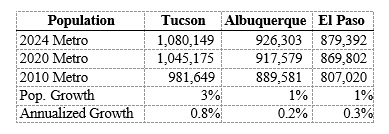
The populations of the three metropolitan areas are similar. However, the 2020 census numbers are much lower. This is simply the result of city limits. Tucson is 241 square miles, Albuquerque is 187 square miles, and El Paso is 259 square miles. All three cities are spread out, accounting for the significant difference in metropolitan population versus census figures. The population of each city is shown in the following table.

Population Growth
The populations of all three cities have grown by a small amount from 2020 to 2024, and at a generally similar pace of 0.8%, 0.2%, and 0.3%. Tucson is the only city that is currently growing at a faster rate than it was from 2010 to 2020. From 2010 to 2020, Tucson grew at 0.6%, Albuquerque at 0.3%, and El Paso at 0.8% annually.
Median Household Income
The U.S. median household income was $80,610 in 2022. All three cities have a lower median household income than the national median. Fortunately, all three cities have posted an increase in median household income from 2022. The lower wages are attributed to the proximity to the border and inexpensive living costs. Albuquerque stands above the other two cities, while Tucson and El Paso have a similar 2023 median household income. Unfortunately, there are concerns with high rates of poverty in all three cities.

Top 10 Employers
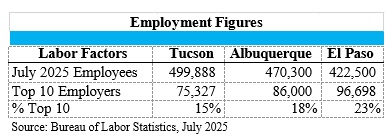
The top 10 employers in Tucson account for over 75K jobs in 2020. In Albuquerque, the top 10 employers account for over 86K jobs in 2023, and for El Paso, over 96K jobs. A military base is one of the top 3 employers in each of the sister cities, and governmental entities account for most of the jobs. Of the three cities, Tucson has the most private employers in the Top 10 with Raytheon, Banner, Freeport, and Walmart. Education and healthcare represented most of the top 10 in El Paso.
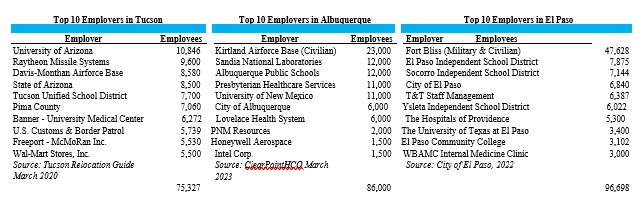
The top 10 employers account for 15% of the total workforce in Tucson, 18% in Albuquerque, and 23% in El Paso. Tucson has the largest number of employees, followed by Albuquerque, then El Paso. Generally, the number of employees correlates with each city’s population. The Tucson labor force is considered less risky than its counterparts since the top 10 employers account for the fewest number of total jobs.
Student Population
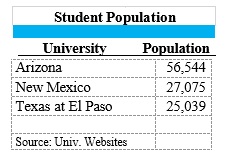
All three cities have a State University with a significant impact on the local economy. The University of Arizona (UA) is the largest of the three and has the largest impact on the local economy and politics. The University of New Mexico (UNM) and Texas at El Paso (UTEP) also have a significant positive impact on their respective communities. From the previous 2023-2024 academic year, the UA has grown by 6%, UTEP had growth of 3%, and UNM had the greatest growth at nearly 7%. The table below shows the enrollment of the three universities, for the 2024- 2025 academic year. As of September of 2025, the Fall 2025 enrollment figures were not released for all three universities.
New Home Permits
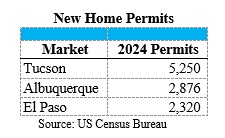
The number of new home permits includes single family and multi-family residences. Tucson shows much higher new home permits for 2024. On the other hand, Albuquerque and El Paso show generally similar new home permit figures.
Airport Statistics
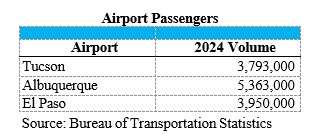
The three airports vary greatly in arrival/departure statistics. The main reason Albuquerque’s traffic volume is much higher than Tucson and El Paso is that the city is distant from surrounding metropolitan areas. Albuquerque also receives a greater amount of volume from tourists traveling to nearby cities in the northern part of state, including Santa Fe and Taos. Tucson posts smaller figures since it is close to Phoenix’s airport, which has more travel options and often offers lower prices. The airport traffic statistics are shown in the following table.
Source: Bureau of Transportation Statistics https://www.transtats.bts.gov/airports.asp
Building Type Breakout
Next, we will discuss the hotel, apartment, industrial, office, and retail markets for each city. This discussion will illustrate each community’s strengths and areas for improvement.
Hotel
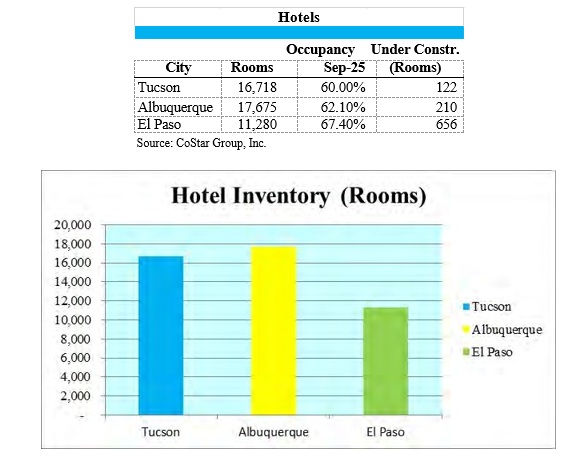
The hotel sector has been generally stable across the three sister cities. In addition, new rental options such as Airbnb, VRBO, and other online options have become significant competitors to the conventional hotel market. The hotel room statistics in Tucson and Albuquerque are generally similar in terms of room count and occupancy. The El Paso market has the fewest rooms, but also has the highest occupancy and rooms under construction. All three cities are adding new rooms, which suggests continued demand for conventional hotels in the three markets.
Apartments
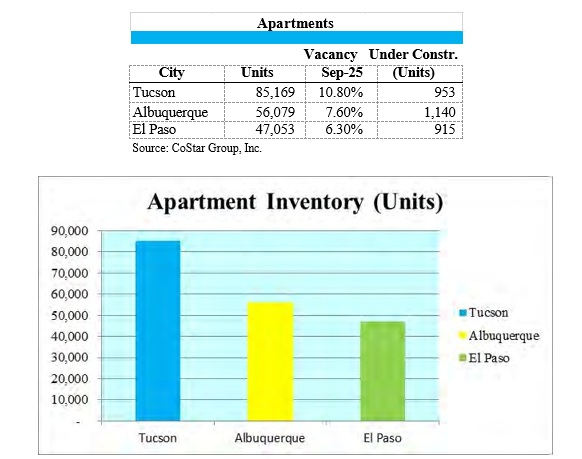
The Tucson market has the most apartment units of the three markets by a large margin. Tucson could have the most units of the three markets for several reasons. First, Tucson has the largest university of the three markets and the largest metro population of 1.08 million, versus 926K in Albuquerque, and 879K in El Paso. Secondly, Tucson has the lowest median household income of the three markets at $55K, versus $68K in Albuquerque, and $59K in El Paso. In the past, higher home prices in Tucson than the other two markets could have spurred new apartment development, to offer a lower priced housing option, but this is currently not the case. According to Redfin, the median home price in Tucson is at about $325K, versus $350K in Albuquerque, and $250K in El Paso. In the past, rental rates in Tucson could have been higher than those in the other two cities, but this is currently not the case either. According to CoStar, the average effective rent is $1,278 in Albuquerque, $1,075 in El Paso, and $1,137 in Tucson. Over 900 new units are being constructed in all three markets. El Paso also has the largest military base of the three markets with housing options on the base. This could be why El Paso has the fewest units of the three cities. Another variable to consider is that Tucson is closer to large Phoenix and California developers than the other two markets, saving time and money for construction and shipping materials.
Industrial
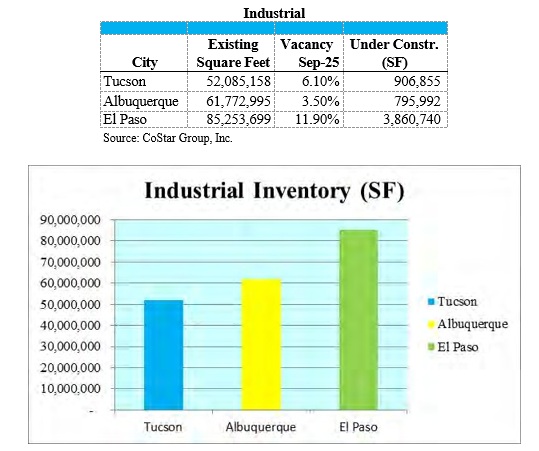
The industrial market is a good indication of manufacturing, production, distribution, and supply in a particular market. As shown in the table and graph below, El Paso has the largest industrial market. This is primarily due to the city’s location along the US-Mexico border. El Paso has become a logistics hub, but vacancy has shot up with exposure to tariffs and increased US-Mexico border restrictions. Albuquerque has the second-largest industrial market. The reason for this is that Albuquerque is distant from surrounding cities and therefore a more desirable geographic location for the distribution hubs and supply centers in between larger cities in the western United States, such as Los Angeles, Denver, Phoenix, and Oklahoma City. Tucson has the smallest industrial market which is primarily due to Phoenix being 100 miles to the north with a larger population, airport, and vicinity to surrounding cities. All three of the cities industrial inventory has grown from 1.9% - 10.6% from 2024 to 2025. El Paso added over 8.16 million square feet and Albuquerque added 1.31 million square feet of new space during this time period. Tucson also added about 950K square feet of new industrial space. The vacancy rate in two of the three cities has increased, especially in El Paso which was 7.10% in 2024 and now is 11.90%. The vacancy in Albuquerque increased from 2.70% in 2024 to 3.50% in 2025, while Tucson’s rate decreased from 6.40% to 6.10%. There are new facilities under construction in all three markets, showing continued demand for industrial space in all three markets.
Office
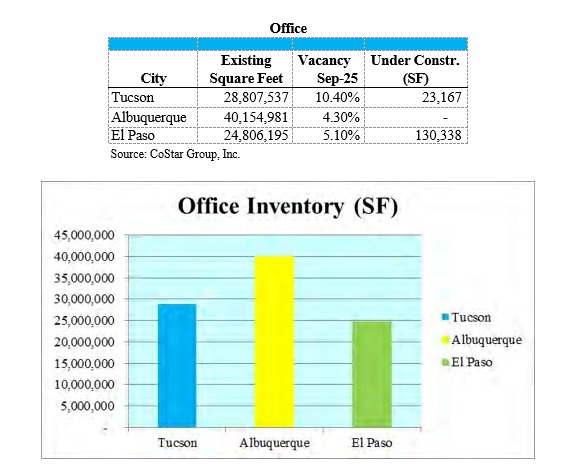
The office market represents the corporate and small business market, financial strength, medical space, and production of a city. In 2025, employees have mostly returned to an office or a hybrid schedule. Albuquerque has the largest office market of the three cities. Once again, this is due to Albuquerque serving as a hub for New Mexico. Tucson has a smaller office market and this is due to Phoenix serving the large corporations in the region. Tucson and El Paso both had a decrease in office inventory from 2024 to 2025, about 156K in Tucson, and 776K in El Paso, which means buildings were either razed or redeveloped into another type of use. The Albuquerque office inventory grew by about 683K from 2024 to 2025. The vacancy rate for all three cities varied during this time period, with Albuquerque showing a slight decline from 4.80% in 2024, and is now at 4.30%. The vacancy rate in Tucson for 2025 is 10.4%, a decrease from 10.8% in 2024, while El Paso’s rate decreased from 5.50% to 5.10%. Tucson and El Paso have a small amount of office space currently under construction.
Retail
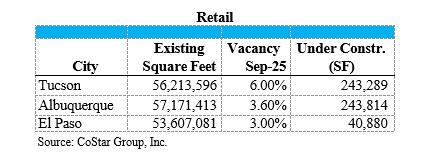
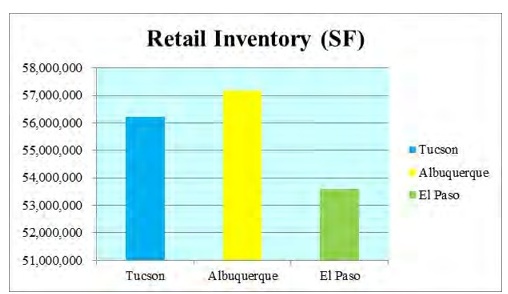
The retail market represents expenditure income, tourism, as well as the contributions related to the retirement and student populations. Notably, that there is a large influx of shoppers from Mexico seeking higher end products and a ‘shopping experience’ in all three cities, but primarily in El Paso and Tucson. All three cities have a similar sized retail market. All three cities have a slightly smaller retail market than in 2025. El Paso’s retail market shrank by about 609K, 495K in Albuquerque, and 326K in Tucson. This means that retail space has been razed or redeveloped into another type of use. The vacancy rate in all three cities did not fluctuate much, with Tucson’s rate increasing from 5.70% in 2024 to 6.00% in 2025, Albuquerque’s rate is the same at 3.60%, and El Paso’s rate increased from 2.50% in 2024 to 3.00% in 2025.
Conclusions
The three cities serve a similar demographic population, with military personnel, students, and retirees. The communities are similar in size and unsurprisingly have similar sized industrial, office, and retail markets. The hotel and apartment sizes vary between the three markets. All three cities have a downtown that is under revitalization, a civilian rail transportation system that was recently completed or under construction, and are actively managing water concerns. The markets are operating in a period of slow but steady growth.
Statistically, Albuquerque appears to be in the best geographical position and has capitalized on its strengths. Albuquerque has low vacancy rates across the five property types analyzed but has also been slow to add inventory. Albuquerque also has the highest airport volume and median household income of the three cities. Overall, Albuquerque benefits from being the hub of New Mexico, good weather, and having low vacancy rates for the five major property types.
Tucson has done a good job of catering to the university market, and has the largest employment base of the three cities. Because Tucson is the largest of the three cities and has the largest university of the three cities, it has the potential for a more educated community. Tucson benefits from its vicinity to the border, and it could also further benefit from its vicinity to Phoenix, especially if Tucson had a connecting light rail system. Tucson could improve on catering to industry and collaborating with Phoenix. Tucson could further offer tax incentives, political cooperation, and improved infrastructure to cater to existing and potential employers. Tucson’s growth seems to be stunted by a lack of an east-west highway/freeway through the city. However, Tucson has great potential for growth with a large population base and student population, but it is in the shadow of a larger city.
El Paso appears to have captured the US-Mexico border business such as cold storage and retail, while catering to large manufacturers, and distribution centers to grow local jobs. The city’s safety is also appealing for growth and existing citizens. El Paso’s industrial market has strengthened the most of the three cities over the past decade, with significant delivery of new inventory. Overall,
El Paso has capitalized upon its location along the US-Mexico border, its large military base, and is well-positioned in the market. The industrial vacancy did increase in the last year, likely due to tariffs and new US border policies.
All three cities are similar metropolitan areas, although with their distinct strengths and weaknesses. There is a long-term trend for all three cities that could be concerning in the future. All three cities now have large solar power projects, which will most likely expand further. The growth rates for all three cities have slowed down from 2010-2020 levels. The three markets highlighted received an influx of people during the pandemic. However, there are population shifts back to larger cities. These larger metropolitan areas attract young professionals because they offer more job opportunities, amenities, and greater variety of services. This trend could change, as these three sister cities offer sunny weather, affordability, outdoor activities, and are less likely to be impacted by natural disasters. These three cities could also market their strengths better to attract younger talent.
Recommendations
The three sister cities may already be in the process of following these recommendations but there is no harm in repeating them. The cities could coordinate with one another and build alliances to serve a network for manufacturing and distribution. For a city to be appealing, the fundamentals must be addressed. These fundamentals include having a safe and clean place to live, good education, and strong youth programs. Unfortunately, homelessness and mental health issues have intensified in all three cities, but this appears to be occurring nationwide. There is an ongoing challenge to address the problem, but it appears to be a symptom of our nation’s current society, and needs to be addressed. A legislation and political system that is cooperative with the community and surrounding communities is also key for all three cities.
The cities could also have water issues going into the future so this could be an opportunity for the cities to team up with each other to creatively deal with the problem. The cities will likely be reusing (not recharging) their water in the future so the sooner the infrastructure is in place, the better. El Paso appears to be ahead of the other two cities in this regard, but it is still better to have diverse and varied water sourcing options. Another option would be to pipe in water from an area with a surplus of water, or desalinate water in the nearby Gulf of Mexico, and to construct a pipeline from there. The cities could invest in a pipeline structure together. Water harvesting programs and incentives to reduce water use could also be implemented in each city.
Lastly, these sister cities could offer better infrastructure. All three cities benefit from a high number of sunny days. Large scale solar energy has been in-progress for all of the sister cities, but will only continue to grow with public support. There are also “mechanical trees” that remove carbon dioxide from passing air that could be utilized in all three cities, as temperatures quickly rise in the region. AI and data centers will continue to be a balance in these cities with limited resources, and also keeping up with modern technology. As previously mentioned, water will be a continuous battle in the southwest, so adding water harvesting, gray water lines, and reclaimed water lines to golf courses, car washes, and parks will be helpful going forward. Improving the educational systems, either individually or collectively between the cities promotes responsible growth, infrastructure, and maintenance of the unique culture of each community. Preserving and promoting art, history, and culture is also an important piece to include in the infrastructure for each of these historically and culturally rich cities. Having art districts, murals, and other creative projects is an important and often overlooked part of a city’s infrastructure. All these factors would improve the cities appeal to employers, families, students, young professionals, and retirees.
The purpose of this analysis is to show the strengths and weaknesses of the three sister cities. The primary goal is to help achieve an improved quality of life for each. The secondary goal is to have a long-term, sustainable future and to grow demand in the region. Growth is typically perceived as a positive thing. However, thoughtful growth, a long-term plan that serves a greater purpose, provides even greater benefits to a region.
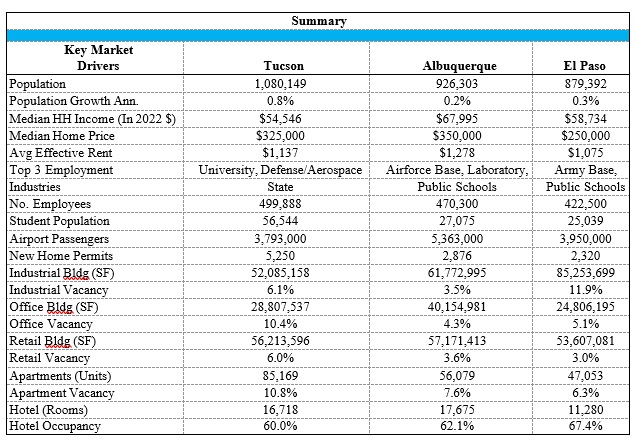
Summation of Sister City Key Comparison Take-Away’s
 Ajay has experience throughout the State of Arizona, with primary experience in Southern Arizona and the Navajo Nation. Ajay is a designated member of the Appraisal Institute (MAI) and is licensed as a Certified General Real Estate Appraiser in the States of Arizona, New Mexico, and Utah. Ajay has experience in apartments, student housing, vacant land, subdivisions, office buildings, retail buildings, service stations, industrial buildings, mobile home parks, self-storage facilities, business site leases, and special-use properties. Ajay’s clients include private individuals, corporate organizations, banks, attorneys, and governmental agencies. Ajay has experience preparing reports for conventional lending, SBA, litigation work, eminent domain work, consultations, and appraisal reviews.
The ‘Tale of Three Cities’ series first appeared in the Real Estate Daily News in August 2023 and was later revisited in June 2024. See Tale of Three Cities – Revisited 8-2023 - Real Estate Daily News, and Tale of Three Cities – Revisited 6-2024 - Real Estate Daily News
For a PDF version of this report, click here: https://realestatedaily-news.com/wp-content/uploads/2025/09/Tale-of-3-Cities-Revisited-9-2025.pdf