


 PHOENIX (Feb. 26, 2026) – First American Data & Analytics, a leading national provider of property-centric information, risk management and valuation solutions and a division of First American Financial Corporation (NYSE: FAF), today released its January 2026 Home Price Index (HPI) report. The report tracks home price changes less than four weeks behind real time at the national, state, and metropolitan (Core-Based Statistical Area) levels and includes metropolitan price tiers that segment sale transactions into starter, mid, and luxury tiers. The full report can be found here.
"Twenty-three of the top 30 markets recorded annual declines, while national appreciation held below 1 percent," says Chief Economist Mark Fleming.

Highlights
- Annual house price appreciation remained below 1 percent for the sixth consecutive month in January.
- House price growth reported in last month’s HPI for November 2025 to December 2025 was revised down by -0.07 percentage point, from -0.17 percent to -0.24 percent.
“January’s data suggests that house price appreciation started 2026 much the way it ended last year—subdued,” said Mark Fleming, chief economist at First American. “Prices declined modestly on a monthly basis and annual appreciation remained under 1 percent for the sixth consecutive month. The era of rapid price acceleration is long past, replaced by a market with price changes essentially flat on an annual basis. For buyers, that stability is meaningful. Soft price growth, combined with faster rising household incomes, continues to gradually improve affordability.”
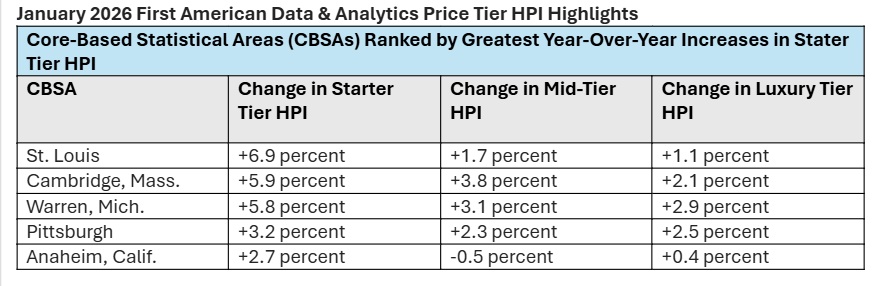
January 2026 Local Market Price Tier Highlights
The First American Data & Analytics HPI segments home price changes at the metropolitan level into three price tiers based on local market sales data: starter tier, which represents home sales prices at the bottom third of the market price distribution; mid-tier, which represents home sales prices in the middle third of the market price distribution; and the luxury tier, which represents home sales prices in the top third of the market price distribution.
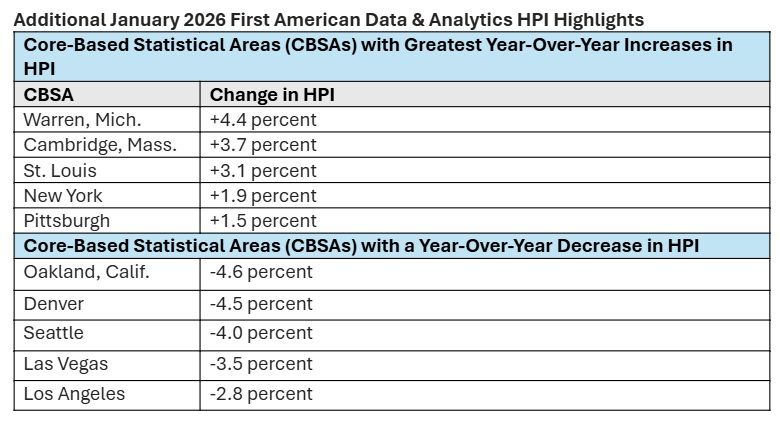
“Price trends remain uneven across markets, but falling prices are becoming more common,” said Fleming. “Twenty-three of the top 30 markets posted annual price declines, compared with 20 markets that were flat or declining the month before. Midwestern and Northeastern markets continue to lead appreciation, with Warren, Mich., Cambridge, Mass., and St. Louis posting the strongest gains, while several Western markets—including Oakland, Denver, and Seattle—rank among those with the largest annual decreases. In a nationally stable market, local supply and demand dynamics continue to dictate performance.”
- Phoenix-Mesa-Chandler, AZ saw overall single-family home prices decline -2.4% year-over-year
- Phoenix-Mesa-Chandler, AZ saw single-family home prices in starter price segment decline -3.9% year-over-year
- Phoenix-Mesa-Chandler, AZ saw single-family home prices in mid-tier price segment decline -3.4% year-over-year
- Phoenix-Mesa-Chandler, AZ saw single-family home prices in luxury price segment decline -0.9% year-over-year
HPI data for all 50 states and the largest 30 CBSAs by population are available here.
Visit the First American Economic Center for more research on housing market dynamics.
January 2026 First American Data & Analytics House Price Index: Frequently Asked Questions
Q: What is the First American Data & Analytics Home Price Index (HPI)?
A: The First American Data & Analytics Home Price Index (HPI) measures changes in single-family home prices across the United States using a repeat-sales methodology. It tracks price movements at the national, state, and metropolitan (Core-Based Statistical Area) levels and includes starter, mid-tier, and luxury price segments.
Q: What did the January 2026 HPI report find at the national level?
A: National house prices declined 0.2 percent month over month (December 2025 to January 2026) and increased 0.4 percent year over year (January 2025 to January 2026), with annual appreciation remaining below 1 percent for the sixth consecutive month.
Q: What is driving subdued to flat house price growth nationally?
A: According to First American Chief Economist Mark Fleming, the era of rapid price acceleration has long past, and the market has shifted to a period of relative price stability. Slower price growth, combined with rising household incomes, is gradually improving affordability for buyers.
Q: Which markets experienced the strongest price growth in January 2026?
A: Among major markets, Warren, Mich., Cambridge, Mass., and St. Louis posted the strongest annual home price appreciation. Starter-tier growth was particularly strong in St. Louis, Cambridge, and Warren.
Q: Which markets saw the largest price declines?
A: Oakland, Calif., Denver, Seattle, Las Vegas, and Los Angeles recorded the largest year-over-year house price declines among major metropolitan areas.
Q: How does stable price growth improve housing affordability?
A: When home prices grow more slowly than incomes, affordability improves over time. January’s data indicates that subdued price growth is contributing to gradual gains in affordability.
Q: How current is the First American HPI data?
A: The HPI tracks home price changes less than four weeks behind real time, making it one of the timeliest measures of U.S. home price trends available.
Q: Who produces the First American HPI?
A: The HPI is produced by First American Data & Analytics, a division of First American Financial Corporation (NYSE: FAF), using more than 46 million paired real estate transactions and the industry’s largest property and ownership dataset.
Q: When will the next HPI report be released?
A: The next First American Data & Analytics Home Price Index report is scheduled for release during the week of March 16, 2026.
First American Data & Analytics HPI Methodology
The First American Data & Analytics HPI report measures single-family home prices, including distressed sales, with indices updated monthly beginning in 1980 through the month of the current report. HPI data is provided at the national, state and CBSA levels and includes preliminary index estimates for the month prior to the report (i.e. the preliminary result of July transactions is reported in August). The most recent index results are subject to revision as data from more transactions become available.
The HPI uses a repeat-sales methodology, which measures price changes for the same property over time using more than 46 million paired transactions to generate the indices. In non-disclosure states, the HPI utilizes a combination of public sales records, MLS sold and active listings, and appraisal data to estimate house prices. This comprehensive approach is particularly effective in areas where there is limited availability of accurate sale prices, such as non-disclosure states. Property type, price and location data are used to create more refined market segment indices. Real Estate-Owned transactions are not included.