


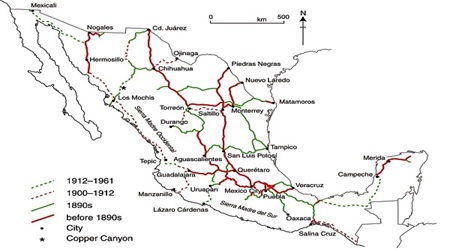
Mexico's Rail Expansions are commendable, from the Isthmus of Tehuantepec as an alternative to the Panama Canal to the Mexico City - Nogales passenger corridors
TUCSON, AZ (July 22, 2025) - Mexico has officially launched one of its most ambitious infrastructure undertakings in decades: an $8 billion investment in passenger rail that includes a direct line from Mexico City to the border city of Nogales, Sonora. Part of the country’s National Railway Plan, the project will span over 3,000 kilometers and reconnect Mexico through high-capacity passenger corridors. The implications for economic development, real estate investment, and cross-border integration are enormous.
The Ministry of Infrastructure, Communications, and Transportation (SICT) is overseeing the phased rollout of four major intercity lines as part of the plan’s first phase. Construction began in 2023 with the Mexico–Pachuca and Mexico–Querétaro segments, followed by the Querétaro–Irapuato and Saltillo–Nuevo Laredo corridors, both of which are expected to open in July 2025. These four routes will cover 786 kilometers and form the foundation of a broader 3,000-kilometer passenger network that will eventually extend to key border crossings, including Nogales and Nuevo Laredo.
Once complete, the Mexico–Nogales line will serve as the northernmost terminus of the system. The route is expected to connect over 49 million people, enhancing regional mobility and economic integration across six suburban zones, 11 municipal metropolises, and 19 metropolitan areas. The expansion also includes federal collaboration between the SICT, Ministry of National Defense (SEDENA), Ministry of the Environment (SEMARNAT), and the Ministry of Agrarian, Land and Urban Development (SEDATU).
Real estate experts and economic developers on both sides of the U.S.–Mexico border are closely tracking progress. Nogales, Sonora, stands to benefit significantly from station-area development, with opportunities for transit-oriented housing, retail, and tourism-related infrastructure. The ripple effects could extend into Nogales, Arizona, with increased cross-border visitation and new demand for mobility-focused investment.
The National Railway Plan is being hailed as a catalyst for regional growth, with projections suggesting up to 1 million jobs could be generated during construction and operations. It also aims to reduce Mexico’s carbon footprint by offering a low-emissions alternative to road and air travel. Faster travel times and increased access to economic centers are expected to boost productivity and reduce environmental impact.
North of the border, Arizona is advancing its own intercity rail ambitions. In June 2025, the Federal Railroad Administration approved a Service Development Plan for the proposed Tucson–Phoenix rail corridor. Led by the Arizona Department of Transportation (ADOT), the plan will evaluate route alignments, station siting, ridership demand, and capital investment over the next two to three years. The proposed line would serve key nodes including Tucson, Eloy, Coolidge, Sky Harbor Airport, Tempe, and downtown Phoenix, with a western terminus in Buckeye.
Despite this progress, there is no formal U.S. rail project connecting Nogales to Tucson, though the corridor is referenced in statewide planning documents. A route following I-19 and existing Union Pacific tracks is widely viewed as logical, but it has not yet received funding or undergone a technical review. Many consider it the critical missing link, especially as Mexico pushes ahead with its northern expansion.
Taken together, the Mexico–Nogales passenger rail and the Tucson–Phoenix corridor represent a historic reimagining of regional mobility. Both projects have the potential to reshape how people and goods move across the Arizona–Sonora Megaregion, with wide-ranging implications for tourism, housing, labor access, and long-term economic competitiveness. Completing the final segment—from Nogales to Tucson—may ultimately define the success of a truly binational rail network.
This initiative aligns with Mexico’s $7.5 billion Interoceanic Corridor railway, currently under construction across the Isthmus of Tehuantepec, as a strategic alternative to the Panama Canal. The Panama Canal has been strained due to historic drought conditions and rising tolls. The 188-mile rail line allows containers to be offloaded from ships on one coast, transported by rail across southern Mexico, and reloaded for shipment on the opposite coast. Originally opened in 1907 and abandoned after the Panama Canal opened, the revived corridor aims to modernize trade logistics while driving economic growth in the impoverished states of Veracruz and Oaxaca. The project includes 10 intermodal stops and ports on both the Gulf and Pacific coasts. It may ultimately connect to the Tren Maya system, extending Mexico’s integrated rail network into the Yucatán Peninsula.