


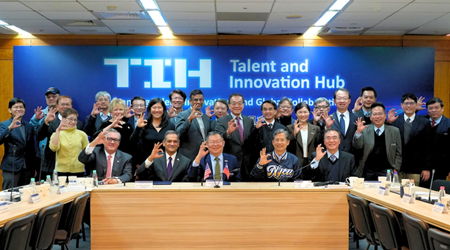
TUCSON, AZ (Feb. 6, 2026) — As Arizona’s semiconductor manufacturing surge reshapes the state’s economy, the University of Arizona has formalized a new international workforce partnership aimed at scaling the talent needed to support the industry’s next-gen chip workforce and develop a skilled chip workforce to ensure sustainable growth. This partnership reflects a broader trend in the tech industry where cooperation between educational institutions and global partners is vital for cultivating a workforce that is not only technically proficient but also capable of navigating an increasingly interconnected world.
According to a University of Arizona News report by Stacy Pigott, Office of Research and Partnerships, the University of Arizona, on Jan. 28 in Taiwan, signed an agreement with National Yang Ming Chiao Tung University to establish a training pipeline designed for a globally connected high-tech economy that will enhance the chip workforce. By integrating practical training with theoretical knowledge, this initiative seeks to create a curriculum that will prepare students for the complexities of modern semiconductor manufacturing, addressing both current and future demands.
This initiative is crucial to ensuring a robust chip workforce capable of meeting future demands. It is not just about filling positions; it is about creating a workforce that is innovative, adaptable, and ready to tackle the challenges posed by rapid technological advancements and global market shifts.
This initiative is crucial to ensuring a robust chip workforce that can meet future demands and contribute effectively to the industry. As semiconductor technologies evolve, the skills required will also change, making continuous education and training essential components of workforce development.
The agreement was signed by Suresh Garimella and NYCU President Chi-Hung Lin, and is framed as a strategic move tied directly to Arizona’s growing role in the global semiconductor ecosystem. This partnership not only strengthens academic ties but also positions both institutions at the forefront of semiconductor innovation, necessary for future economic growth in Arizona and Taiwan.
From K-12 to graduate research: building a workforce at scale
The UA News report describes the initiative as spanning the entire talent pathway, from technician training to advanced R&D. One early-stage example highlighted is a collaboration in Chandler with a local high school to launch, according to UA, the nation’s first career and technical education program tailored specifically for semiconductor technician training. This program aims to attract students to the semiconductor industry from a young age, fostering interest and providing foundational skills that will be crucial as they progress through their education.
At the university level, UA and NYCU students will have options that include dual-degree pathways, industry-aligned master’s programs, minors, and certificates, as well as research collaborations. These opportunities are designed to ensure that graduates are not only equipped with theoretical knowledge but also possess hands-on experience, making them highly competitive in the job market.
Technical skills plus cultural fluency
A distinctive feature of the partnership is its emphasis on preparing students for a truly global industry—pairing engineering training with cross-cultural competence. UA’s semiconductor workforce strategy includes “Mandarin for Industry” coursework, while NYCU students will strengthen English skills through exchange programs, internships, and hands-on projects, with student cohorts in Arizona and Taiwan working on shared real-world challenges. By learning each other's languages and cultural nuances, students will be better prepared to collaborate on international projects, fostering innovation across borders.
The article notes that these “vertically integrated” and capstone-style collaborations are intended to sharpen communication and build the trust required in international teams—skills that can be difficult to teach in a traditional classroom setting. This approach not only enhances technical skills but also emphasizes teamwork and collaboration in achieving common goals in the semiconductor sector.
Embedded in Arizona’s broader economic strategy
UA News also ties the initiative to Arizona’s longer-term economic development positioning, citing the role of the Arizona Commerce Authority and its Arizona–Taiwan Trade & Investment Office in Taipei, as well as investments supported by Pima County Economic Development. This strategic alignment is essential for ensuring that the region remains competitive in the global semiconductor market.
While the program is rooted in semiconductors, the report says plans are already underway to extend the model into adjacent innovation sectors, including photonics, quantum technologies, artificial intelligence, digital health, and smart agriculture. This expansion highlights the training model's versatility and the potential for synergies across various high-tech industries.
Why it matters for Southern Arizona
For Southern Arizona’s business community, the partnership signals a deliberate attempt to connect education, industry needs, and research commercialization—strengthening the region’s role in the state’s high-tech supply chain and helping employers compete for talent as new investment and production capacity comes online. This initiative not only promises to boost employment but also supports economic diversification, making the region more resilient to market fluctuations.
As industries evolve and the challenges of globalization become more pronounced, the need for a skilled chip workforce becomes ever more critical. The collaboration between UA and NYCU is a forward-thinking approach that recognizes the importance of addressing these challenges head-on, ensuring that the workforce is not only skilled but also adaptable to future changes.
Furthermore, by investing in education and training at all levels—from K-12 to graduate studies—Arizona is positioning itself as a leader in the high-tech workforce landscape. This strategy not only enhances the skill set of its current workforce but also attracts businesses seeking a well-trained talent pool, thereby bolstering the economy and creating job opportunities across sectors.
This partnership signifies a pivotal moment not just for Arizona but for the entire semiconductor industry. As demand for chip manufacturing continues to rise globally, initiatives like this one will play a crucial role in equipping a new generation of workers with the necessary skills. The collaboration between UA and NYCU exemplifies how educational institutions can bridge the gap between academic knowledge and practical industry requirements, ensuring that the chip workforce is ready to meet the challenges of tomorrow.
Source: “More than microchips: Arizona’s blueprint for building a high-tech workforce,” by Stacy Pigott, University of Arizona News.