


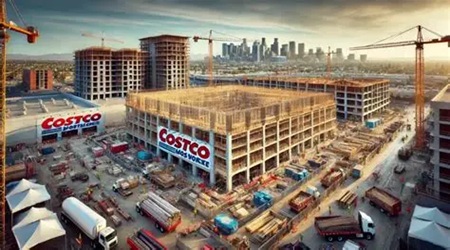
LOS ANGELES, CA (March 13, 2026) — A mixed-use development in South Los Angeles is drawing national attention by combining a new Costco warehouse with 800 apartments above it, creating one of the more unusual large-scale housing and retail projects now under construction in California. The project, known as 5035 Coliseum, is being developed by Thrive Living at 5035 W. Coliseum Street in Baldwin Village. Groundbreaking took place in September 2024.
The project is notable not because Costco is becoming a housing developer, but because the retailer is serving as the anchor tenant in a housing-led mixed-use development. Thrive Living said the plan will place a new Costco store at street level with 800 rental units above, making it the first mixed-use development in the country to feature Costco as the anchor retail tenant.
Of the 800 apartments, 184 units (23%) are designated for low-income households. Thrive Living said the remaining units are intended as non-subsidized affordable and workforce housing, serving families, seniors, and other residents in the surrounding community. The Housing Authority of the City of Los Angeles also lists the development as an 800-unit multifamily project.
On the commercial side, public project materials reviewed by housing officials describe approximately 185,153 square feet of retail space planned for the Costco component. The same materials indicate the development is expected to include roughly 70,000 square feet of open space in addition to the residential and retail uses, underscoring the scale of the six-story project.
The development has also become a closely watched test case for California’s AB 2011, the Affordable Housing and High Road Jobs Act. Thrive Living said 5035 Coliseum was the first project approved in the City of Los Angeles under the law, which provides a faster, by-right approval path for qualifying housing and mixed-use developments on certain commercial sites if they meet affordability, labor, zoning, and environmental standards.
Another reason the project has attracted outsized attention is its capital stack. Thrive Living has said the redevelopment is privately financed and is moving forward without Low-Income Housing Tax Credits or other public subsidy sources typically associated with affordable housing developments. Mayor Karen Bass’s office likewise described the project as entirely privately financed with no public funding.
Backers are pitching the development as both a housing project and an economic development play. Thrive Living said construction is expected to support thousands of jobs, while Costco estimated the new store could create up to 400 permanent jobs once it opens. The retailer plans to operate a full warehouse location with fresh food, pharmacy, optical services, and delivery offerings.
The project is expected to open in 2027. Thrive Living said construction was projected to take about two and a half years from its September 2024 groundbreaking, and Costco CEO Ron Vachris later said the Los Angeles location is expected to debut in 2027.
For commercial real estate and housing observers, the Los Angeles project is significant because it shows how a major retail anchor can support dense residential development on an urban infill site where a conventional standalone warehouse might not pencil out. It also illustrates how states and cities are experimenting with new ways to add housing on underused commercial land without relying exclusively on traditional public subsidy models. That combination has made 5035 Coliseum one of the more closely watched mixed-use projects now underway in California.
It is also not hard to imagine why a project like this catches the attention of people in markets like Tucson. The scale would be different, and the economics would not be the same, but the larger idea is easy to understand. As land becomes more expensive, redevelopment sites become harder to assemble, and communities look for ways to add housing without pushing endlessly outward, mixed-use formats that combine a strong retail anchor with residential density could start to make more sense. Tucson is not Los Angeles, but the same conversations around infill, housing supply, and smarter land use are becoming more relevant here, too.