


(JULY 10, 2026) -- Arizona’s labor market continues to show resilience, but the latest employment data shows a clear slowdown—especially in Southern Arizona.
Statewide, Arizona added 2,000 seasonally adjusted jobs in May, while the unemployment rate rose to 4.8%, above the national rate of 4.3%. On a non-seasonally adjusted basis, the state lost 14,300 jobs during the month, reflecting the usual seasonal slowdown that often accompanies the start of summer.
Economists say employers remain cautious as they navigate economic uncertainty, elevated borrowing costs, rising energy costs and a shrinking labor force. While Arizona is still outperforming many states over the longer term, the pace of hiring has moderated considerably.
For Tucson, the slowdown is more pronounced.
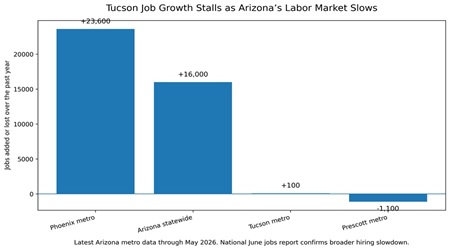
The Tucson metropolitan area added just 100 jobs over the past year, representing virtually flat employment growth of 0.02%. Through May, Tucson employment was down 0.5% year over year, underscoring the region’s continued struggle to build sustained job momentum.
Tucson’s strongest gains came from professional and business services, private education and health services, and other services. But those gains were offset by losses in several key sectors, including leisure and hospitality, government, construction, manufacturing, financial activities, and trade, transportation, and utilities.
The weakness in leisure and hospitality is particularly notable because it mirrors a broader national trend. Across the country, slower consumer spending has weighed on jobs in the accommodation and food services sector, which shed 55,000 positions in June. Those jobs are often an important entry point for younger workers, and the decline points to a softer hiring environment for early-career employees.
Nationally, the June jobs report confirmed a broader hiring slowdown, while the latest Arizona metro data show Tucson’s labor market remained nearly flat through May. According to the U.S. Bureau of Labor Statistics’ Employment Situation Summary for June 2026, employers added just 57,000 jobs nationally, the lowest monthly gain since March. Revisions to April and May job gains lowered prior job gains by 74,000, suggesting the labor market remains fragile even as the unemployment rate ticked down to 4.2%.
That decline in the national unemployment rate was not necessarily a sign of stronger hiring. Economists say it reflected a shrinking labor supply, with more than 700,000 people leaving the labor force in June. Labor force participation fell to 61.5%, down 80 basis points from a year earlier.
The labor supply challenge is being driven by several forces, including retirements, restrictive immigration policy, and slower population growth. The effects are being felt across age groups, but the steepest recent decline in participation came among workers ages 25 to 34. At the same time, employers appear to be favoring more experienced workers and productivity-enhancing technology investments over entry-level hiring.
For Tucson, that trend raises important economic development questions. A region already struggling to generate job growth cannot afford prolonged weakness in sectors that support young workers, service employment, construction activity and small business formation.
Phoenix continues to perform better than the rest of the state. The Phoenix metro area added 23,600 jobs over the past year and posted 0.3% year-to-date job growth through May, slightly ahead of the national pace. Its gains were led by private education and health services and professional and business services.
Tucson, by contrast, remains nearly flat.
Arizona’s overall economy continues to show resilience, but the divide between Phoenix and the rest of the state is widening. In Southern Arizona, the latest numbers point to a labor market that is not collapsing but is not gaining enough ground either.
With higher financing costs, rising operating expenses, and a shrinking pool of available workers, many employers appear content to hold current staffing levels until conditions become clearer. That caution may be understandable, but for Tucson, the challenge is larger: converting long-discussed economic development opportunities into measurable job growth.
U.S. Bureau of Labor Statistics, “The Employment Situation — June 2026